Trump announces $1,00,000 H1-B visa fee
| Date :21-Sep-2025 |
By Yoshita Singh
NEW YORK/WASHINGTON
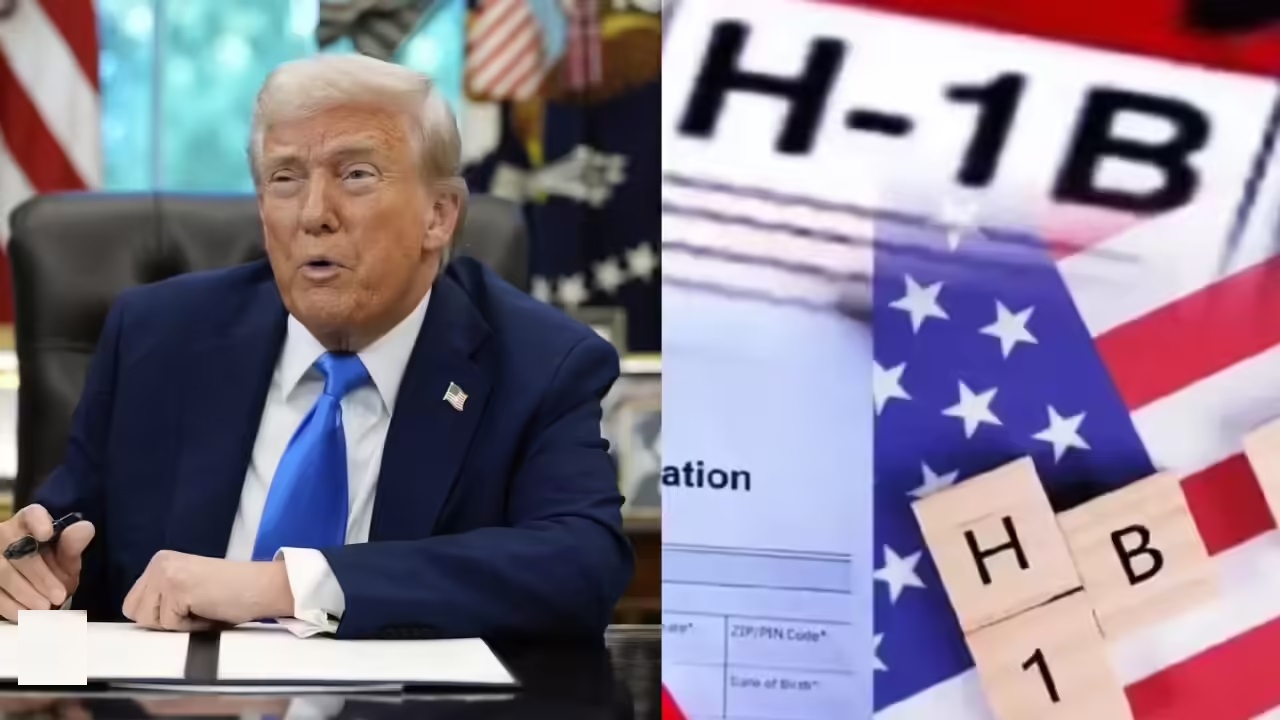
IN A development that could adversely affect Indian professionals in the US, President Donald Trump has signed a proclamation to raise the fee for H-1B visas to a staggering USD 1,00,000 annually, a move described by American lawmakers and community leaders as “reckless” and “unfortunate”.
Trump on Friday signed the proclamation ‘Restriction on entry of certain nonimmigrant workers’, saying the abuse of the H-1B visa programme is a “national security threat”.
Immigration attorneys and companies have asked the H-1B visa holders or their family members currently outside America for work or vacation to return within the next 24 hours or risk being stranded and denied entry into the US after the proclamation comes into effect from 12:01 am September 21.
Currently, the H-1B visa fee ranges from about USD 2000 to USD 5000, depending on employer size and other costs. The visas are valid for three years and can be renewed for another three years.
The move is going to significantly impact Indian technology workers who are hired by tech companies and others on H-1B visas.
Tata Consultancy Services (TCS) is the second-highest beneficiary with 5,505 approved H-1B visas in 2025, after Amazon (10,044 workers on H-1B visas), according to the US Citizenship and Immigration Services (USCIS). Other top beneficiaries include Microsoft (5,189), Meta (5,123), Apple (4,202), Google (4,181), Deloitte (2,353), Infosys (2,004), Wipro (1,523) and Tech Mahindra Americas (951).
In his proclamation, Trump said the H-1B visa programme was created to bring temporary workers into the US to perform additive, high-skilled functions, but it has been deliberately exploited to replace, rather than supplement, American workers with lower-paid, lower-skilled labour.
“The abuse of the H-1B programme is also a national security threat. Domestic law enforcement agencies have identified and investigated H-1B-reliant outsourcing companies for engaging in visa fraud, conspiracy to launder money..., and other illicit activities to encourage foreign workers to come to the US,” he said. Trump said that it is necessary to impose higher costs on companies seeking to use the H-1B programme to address the abuse of that programme while still permitting companies to hire the best of the best temporary foreign workers.
On whether the technology CEOs, who hire foreign workers on H1-B visas, are concerned about the new move, Trump said they’re going to be “very happy”.
Trump ordered that the Secretary of Homeland Security shall restrict decisions on petitions not accompanied by a USD 1,00,000 payment for H-1B speciality occupation workers, who are currently outside the US, for 12 months following the effective date of the proclamation, which is September 21, 2025.
The Secretary of State shall also issue guidance, as necessary and to the extent permitted by law, to prevent misuse of B visas by alien beneficiaries of approved H-1B petitions that have an employment start date beginning before October 1, 2026. It said the restrictions shall not apply to any individual or those working for a company or in an industry, if it is determined that the hiring of such individuals to be employed as H-1B speciality occupation workers is in the national interest and does not pose a threat to the security or welfare of the US. The proclamation said that IT firms in particular have prominently manipulated the H-1B system, significantly harming American workers in computer-related fields.
Noting that the share of IT workers in the H-1B programme grew from 32 per cent in 2003 to an average of over 65 per cent in the last five fiscal years, the proclamation said that some of the most prolific H-1B employers are now consistently IT outsourcing companies.