City’s Biomedical Engineer develops goggles for visually impaired
25 Sep 2025 11:30:10
Staff Reporter :
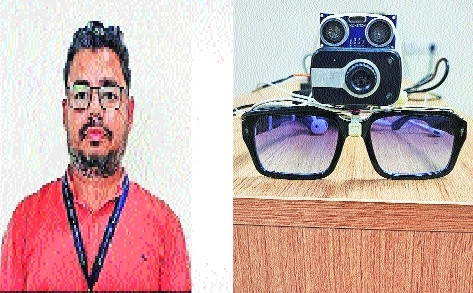
Goggles integrate a USB camera with computer vision, face recognition, and object detection
National Cancer Institute (NCI)’s Biomedical Engineer Ekramul Haque has developed smart goggles for visually impaired individuals. The project is an AI-based wearable assistive device designed to support visually impaired persons. The smart goggles integrate a USB camera with computer vision, face recognition, and object detection. According to Haque, this will provide major support to the visually impaired. Haque’s work has been registered under copyright with the Registrar of Copyrights, Government of India.
With the help of the smart goggles, a visually impaired person can identify the individuals who come across him or her. This is made possible by way of the matching of images that are stored in the database of the goggles.
The objects can also be detected with distance measurement. The user can seek real-time assistance through voice announcements by way of Bluetooth headset, and can also detect moving vehicles along with speed alerts for safety. Haque said that, his innovation was aimed to enhance independent mobility and safety for the visually challenged community by providing real-time situational awareness.
The Smart Goggles project demonstrates the potential of integrating modern technologies to assist visually impaired individuals effectively. By offering real-time assistance for navigation, object detection, and text reading, this device represents a promising step towards independent living for the visually impaired.
General Secretary and Chief Executive Officer of National Cancer Institute Shailesh Joglekar while talking to ‘The Hitavada’ said, “This is a commendable project. Everyone knows the problems being faced by visually impaired in day to day life.
Eye is a delicate and very important organ of the body. The goggle will be highly beneficial to the visually impaired.”
Haque’s project is known by the name of ‘Smart Goggles for Visually Impaired Individuals’ for which he got the copyright.
According to the World Health Organisation (WHO), approximately 2.2 billion people globally experience some form of visual impairment, with millions relying on traditional assistive tools like canes or guide dogs for navigation. While these tools are effective to some extent, they have inherent limitations, such as the inability to provide detailed contextual awareness about the surrounding environment or to read text.
The rapid advancement of technology in fields like computer vision, machine learning, and embedded systems has opened up new possibilities for assistive devices. Wearable technologies have gained prominence as potential solutions due to their portability and ability to integrate multiple functionalities into a single platform. Among these innovations, smart wearables stand out as transformative tools that can bridge the gap between the visually impaired and the visual world.
Smart Goggles project, an initiative in
development of assistive technologies
The Smart Goggles project represents a step forward in the development of such assistive technologies. By integrating a combination of state-of-the-art technologies, including YOLO(You Only Look Once) for real-time object detection, Optical Character Recognition(OCR) for text extraction, ultrasonic sensors for obstacle detection, and text-to-speech (TTS)for auditory feedback, the Smart Goggles aim to provide visually impaired users with enhanced situational awareness. Unlike traditional mobility aids, these goggles offer detailed object recognition, real-time obstacle detection, and the ability to read multilingual text, all delivered in an intuitive and user-friendly manner.