‘Wheel of Divinity’, a pandal that celebrates life’s eternal rhythm
25 Sep 2025 11:10:14
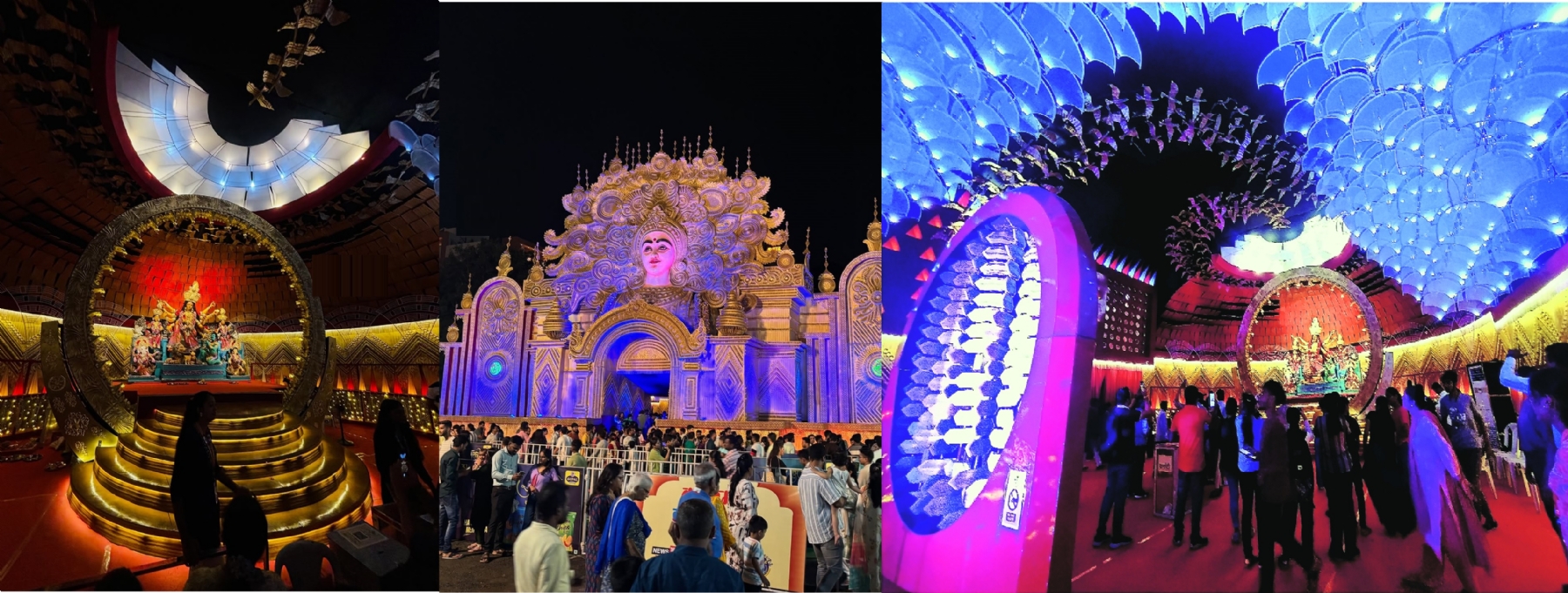
{left }12 feet central idol of Goddess Durga along with idols of Lord Ganesh, Lord Kartikeya, Goddess Saraswati, and Goddess Lakshmi. A
revolving wheel-like installation forms the centrepiece, symbolising ‘wheel of divinity’. (Pic by Satish Raut)
{Right} The entrance of Rani Laxmibai Durga Utsav Pandal, Laxmi Nagar.
By Vaishnavi Pillay :
The nine nights of Navratri turn cities across India into canvases of colour, rhythm, and devotion. In Nagpur too, the season arrives with music in the air, the glow of lights, and the resonance of collective faith.
Among the many pandals dotting the city, the Rani Laxmibai Durga Utsav Mandal in Laxmi Nagar also stands apart, not just for its stunning pandal but for the community spirit that sustains it. When ‘The Hitavada’ visited the pandal, the festive air was unmistakable. Children thronged food stalls, elders gathered in devotion, and groups of youngsters took charge of managing the crowd and other arrangements at the venue.
The Mandal, which marks its 20th year this season, was founded in 2006 by Prasanna Mohile, with the support of nearly 40 families from the Laxmi Nagar locality. Nearly two lakh people walk through its gates during Navratri.
Each year, the Mandal invites artist Nihar Debnath from Kaliaganj, West Bengal, to conceptualise and build a themed pandal.
“This year’s theme, Wheel of Divinity – Srishtichakra, is an artistic meditation on the cycle of life. A revolving wheel-like installation forms the centrepiece,” explained Mohile. The opening and closing of the flaps installed in the interior walls of the pandal symbolise a slow, continuous rhythm. Debnath explained his thought, “Life flows endlessly, with its highs and lows, and has many layers.” Suspended above, a flock of birds in flight complements the wheel. They move together, not in a straight line, but always united, ultimately directed towards the idol of Goddess Durga. “The birds signify that no matter the diversions, everyone must have one aim, one centre, one guiding light,” explained Debnath and added that visitors are encouraged to draw their own interpretations, but the symbolism resonates with focus, unity, and devotion.
The idols too, every year, are crafted in Kolkata by sculptor Pashupatinath, using clay that includes soil from the Ganga river, and the idols of Goddess Durga, Lord Ganesh, Lord Kartikeya, Goddess Saraswati, and Goddess Lakshmi arrive in the city by road. This year, the central idol of Goddess Durga stands tall at 12 feet.
The Mandal is known not just for its installations but also for cultural programming. “We want this to be a wholesome experience for families and devotees, a mix of devotion, art, music, and community,” said Mohile. Entry is free, and every day brings a new programme to the stage. The Bansuri Collective group of 22 young musicians will present a fusion concert, while performances by renowned classical vocalist Rahul Deshpande, kathak exponent Sonia Parchure, and popular singers including Prajakta Shukre, Hemani Kapoor, and Maithili Thakur are on the schedule.
Vice President Shashank Chobe shared, “There is no event management company behind this, only the support of committee members, families, and volunteers. The youngsters who grew up in this committee have taken over many responsibilities. College students join as volunteers. They handle decoration, crowd management, food stalls, music, and cultural programmes. Only when they need final permissions or help do they approach the senior committee.” For volunteers, the festival has become an annual classroom of practical learning, management, teamwork, and responsibility, all wrapped in devotion. Other senior committee members include Amol Anwikar, Treasurer; Niraj Dontulwar, Vice President; and Anand Kajgikar, Secretary. Rani Laxmibai Durga Utsav Mandal, which began with a small group of families, now reflects a blend of devotion, art, culture, and community.