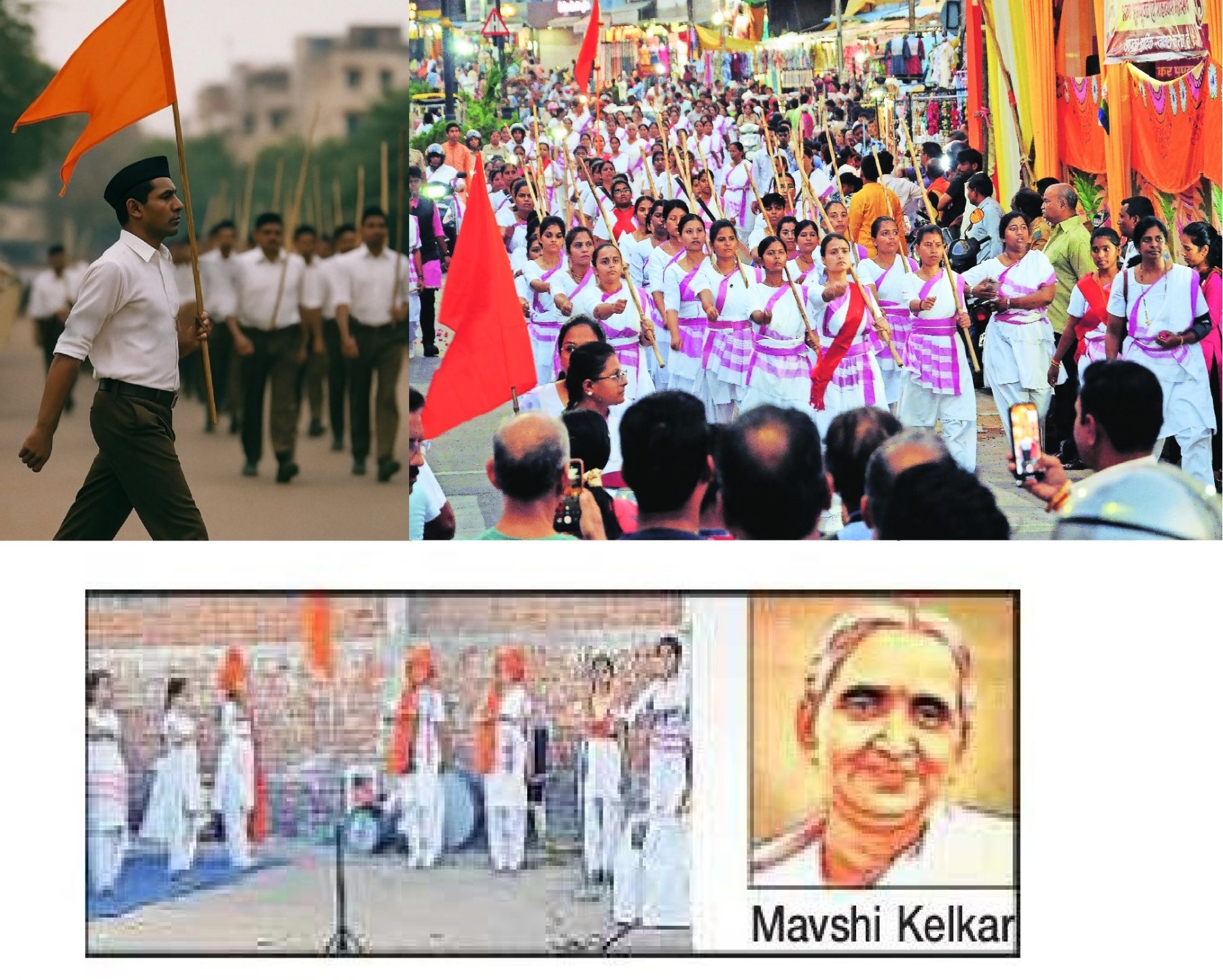
Marching ahead On Aug 14, 1947, Mavshi Kelkar attended ‘shakha’ in Karachi
29 Sep 2025 11:58:40
By Vikas Vaidya :
On the midnight, at a terrace of a house in Karachi in Pakistan, Sevikas of Rashtra Sevika Samiti quietly took a pledge before the saffron flag
Very few knew that just to attend one shakha, Laxmibai Kelkar, popularly known as Mavshi Kelkar, founder and Pramukh Sanchalika of Rashtra Sevika Samiti flew to Karachi in Pakistan that too during partitition in 1947. Imagine that period when women hardly went outside, but Mavshi visited Karachi amidst chaos. How could she go there is another story, but her desperation to go there in such an atmosphere just because someone who had deep patriotic feeling wished so, could be attributed to her intense love for the organisation and for the country.
When Pakistan was celebrating its independence on the midnight of August 14, 1947, everywhere slogans were echoing ‘Khoon Se Liya Pakistan, Lad ke lenge Hindustan’ and Sevikas were taking pledge quietly in front of saffron flag to work for the Samiti and for ‘Bharatmata’ on terrace of a house in Karachi.
Mavshi had founded Rashtra Sevika Samiti, aiming to develop three qualities in women--motherhood, competency and leadership for which she had asked Sevikas to worship Jijamata for motherhood, Devi Ahalyabai Holkar (competency) and Rani Laxmibai of Jhansi (leadership). Work of the Samiti was expanding. By 1943, it had spread across Maharashtra, including Vidarbha, Madhya Pradesh and some parts of Central India. In one of the ‘Vargas’ in 1943, for the first time, a woman named Jethi Devani from Hyderabad Sindh (now in Pakistan) had come.
She had established 10 shakhas at 10 different places in Sindh. It was confirmed that India would become independent in 1947, but afterpartition.
Around the last week of July 1947 or so, Mavshi received an emotional letter from Devani who urged, “Since Pakistan is separated from India, we feel you visit here, attend shakha and oblige us. We want to get committed to render our responsibilities towards India in your presence.”
Mavshi made up her mind to go to Karachi. She asked her son Dinkar and Venutai (Malatitai) Kalamkar to accompany. On August 10, 2025, all three left for Mumbai and stayed at the residence of Jayant and Bakultai Devkule. Now the issue was to leave for Pakistan.
During the time of partition, people were caught in such a sorry situation that they did not know what was the best option. They were running helter-skelter as on ground, there was total confusion with mob in control of the situation. Mavshi’s son-in-law Balasaheb was working in Port Trust at Karachi.
He somehow arranged two flight tickets. Accordingly, Mavshi and Venutai Kalamkar left for Karachi. Jaiprakash Narayan and one Deo from Pune were with them till the flight reached Ahmedabad. Both got down at Ahmedabad and these two brave women continued their journey.
On August 14, 1947, Pakistan had an altogether different atmosphere. Mobs had taken to streets, removing the photos and statues of Indian leaders. On the same midnight, Pakistan was celebrating its independence and Mavshi and Venutai were witnessing a small event where sevikas were taking a pledge to remain committed to their work and towards India.
Jethi Devani writes, “I shall never forget that night when Pakistan was witnessing violence all over. Sevikas in the presence of Mavshi, taking pledge. ‘Wo Raat Andheri thi parantu bahot sunder thi’ (the night wore a darkness but it was very beautiful).”
Mavshi’s presence made a lot of difference and Sevikas continued doing work. They increased the number of shakhas. According to the history, Devani had to come to India in 1948 and she was made Sharirik Shikshan Pramukh. This was the valour of Mavshi Kelkar. She went to Karachi with a passion to respond to one Sevika. This is an example how an organisation grows. Now Rashtriya Swayamsevak Sangh is completing 100 years on Vijayadashmi and Samiti will be organising its 90th Foundation Day next year. One could realise the secret of long existence of these organisations where leaders led by their own examples.