Balancing hawkers’ rights with road safety: Time to amend the SVA
30 Sep 2025 11:04:55
By L P Joshi :
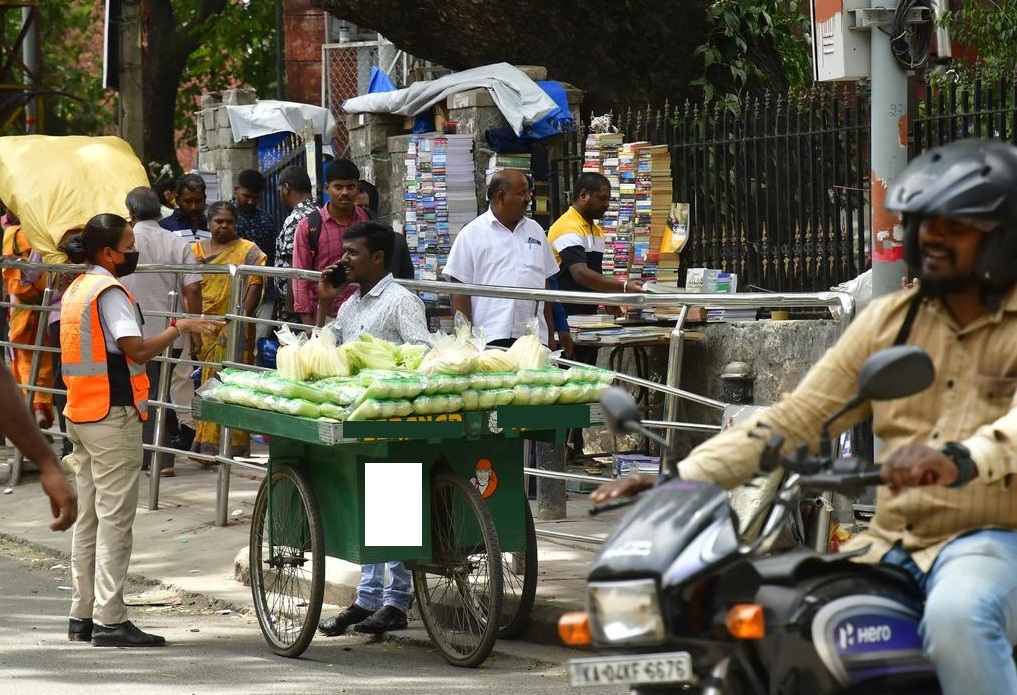
A propos the Nagpur Cityline news (Sep 22) “Hawkers, administration FACE OFF on Sitabuldi Main Rd.” Evidently, the Street Vendors (Protection of Livelihood and Regulation of Street Vending) Act, 2014 (SVA), and the amended Motor Vehicles Act, 1988 (MVA 2022), contain glaring conflicting clauses. The SVA shields hawkers from arbitrary eviction, while the MVA 2022 mandates safe, obstruction-free roads. The conflict arises when vendors occupy footpaths and roads, disrupting traffic and pedestrian movement. Despite its nationwide impact, neither has the Centre addressed this conflict nor has the Judiciary taken suo moto cognisance.
Altering the MVA 2022 is not feasible. The Supreme Court (SC) has consistently held road safety and free movement as part of Article 21—the right to life. Any dilution would be struck down. The logical path is to amend the SVA so that it protects livelihoods without undermining road safety.
Mass roadside vending is a mismatch even in the Indian context of the urban character of modern cities. Roadside vending is historically a rural practice, suited to village markets/haats, but invokes chaos when transplanted into fast-growing cities.
The state government has to set a limit for the permissible number of hawkers for every Tier 1 and Tier 2 city. Sustainable development implies cities must function as cities and villages as villages. Blurring the two breeds congestion, cultural clashes, and declining liveability, which is already visible across India’s urban landscape.
The SVA should be amended to:
1] Restrict vending to designated zones away from traffic arteries.
2] Ban vending on footpaths and roads which are vital to public safety.
3] Insert a clause subordinating vending rights to the MVA 2022.
4] Direct Town Vending Committees to work with the town planning dept and traffic police.
5] Cap hawkers’ numbers at 2,000-4,000 depending on the city’s tier.
This balances “the right to trade” in Article 19(1)(g) with Article 21’s guarantee of safe movement. Vendors’ livelihoods ought to be protected, but not at the cost of safe, well-planned and liveable cities.