Design thinking can lead to competitive advantage, says Dr Abhishek Singh
| Date :08-Sep-2025 |
Business Reporter :
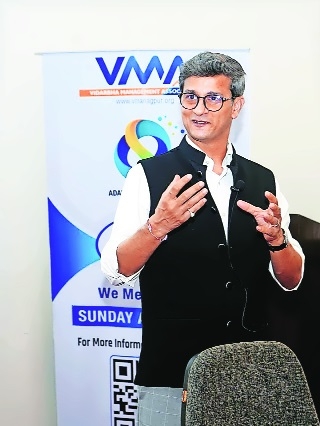
“Design thinking is a hands-on, user-centric approach to problem solving that fosters innovation, and innovation ultimately drives differentiation and competitive advantage,” said Dr Abhishek Singh, faculty member at IMT Nagpur.
He was addressing the Vidarbha Management Association’s (VMA) weekly session held at Chitnavis Centre, where he delivered an engaging session on the power of design thinking in business and beyond.
Dr Singh said that design thinking is a human-centered approach to innovation - anchored in understanding customer needs, rapid prototyping, and generating creative ideas - that can transform the way organisations develop products, services, processes, and strategies.
Dr Singh emphasized the three essential lenses of design thinking: desirability, feasibility, and viability. He elaborated on the five key stages of the process. The first stage – ‘empathy’, involves learning deeply about the audience for whom solutions are being designed. The second stage – ‘define’, focuses on reframing and sharpening questions based on insights gathered during empathy. The third stage – ‘ideate’, encourages brainstorming and the generation of multiple creative solutions. The fourth stage – ‘prototype’, is about building tangible representations of ideas to demonstrate to others. Finally, the ‘test’ stage involves returning to users for feedback, refining, and improving solutions.
He also explained the tools that support each stage of this journey.
For empathy, observation and interviews play a vital role; in the define stage, user personas, customer journey mapping, multiple “why’s” and problem-reversal methods are used. Ideation benefits from techniques such as brainstorming, round robins, convergent and divergent thinking, and ‘MoSCoW’ prioritization tool, etc. Prototyping can be facilitated through storyboarding, role plays, paper models, and digital prototypes, while testing can include feedback grids and Edward de Bono’s six thinking hats.
Anup Wankhede moderated the session while Hemant Zunjurkar was session in-charge.