E-com, food delivery services largely unaffected by gig workers’ strike
| Date :01-Jan-2026 |
NEW DELHI :
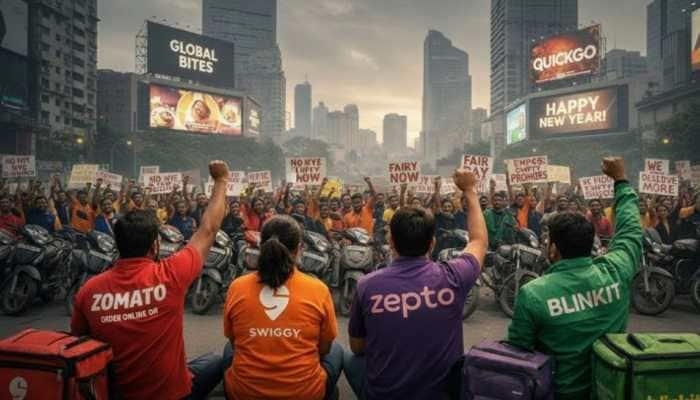
A SECTION of gig workers on Wednesday stopped work demanding better pay and work conditions but the agitation had little impact on services on e-commerce and online food delivery platforms that saw robust business on New Year Eve.
While at some places gig workers staged demonstrations, firms like Zomato, Swiggy offered more incentives to delivery partners, a standard practice on festive periods, to ensure minimal disruptions in services on New Year’s Eve.
Telangana Gig and Platform Workers’ Union (TGPWU) and Indian Federation of App-Based Transport Workers (IFAT) have claimed that lakhs of workers are set to join the nationwide strike to demand better payouts and improved working conditions.
While the workers’ bodies claimed that many of their members, who are associated with food delivery and quick commerce firms like Zomato, Swiggy, Blinkit, Instamart, and Zepto, have stayed away from work, company insiders said it is business as usual for them on New Year’s Eve. Amid the strike call, Zomato offered delivery partners payouts of Rs 120-150 per order during peak hours between 6 pm and 12 am on New Year’s Eve.
The platform has also promised earnings of up to Rs 3,000 over the course of the day, subject to order volumes and worker availability, people in the know of the development said. In addition, Zomato has temporarily waived penalties on order denials and cancellations, they said, however, stressing that it was a standard operating protocol followed during high-demand festive and year-end periods.
“This is part of our standard annual operating protocol during festive periods, which typically see higher earning opportunities due to increased demand,” an Eternal spokesperson told PTI.
Eternal owns Zomato and Blinkit brands.
Similarly, Swiggy has also increased incentives around the year-end period, offering delivery workers earnings of up to Rs 10,000 across December 31 and January 1, according to people aware of the development.
“At Swiggy, we are committed to empowering our delivery partners. As part of our standard process, enhanced incentives are offered on special occasions such as festivals, allowing delivery partners to benefit from increased earning opportunities during peak demand periods across the year,” the company said.
On New Year’s Eve, the platform is advertising peak-hour earnings of up to Rs 2,000 for the six-hour period between 6 pm and 12 am, in a bid to ensure adequate rider availability during one of the busiest ordering windows of the year, they said, maintaining that increased payouts were a standard practice during such periods.
In a joint statement, TGPWU and IFAT said, “As of last night, over 1.7 lakh delivery and app-based workers across India have confirmed participation, with numbers expected to rise further by evening.”
Low pay, long hours and lack of security push gig workers to the edge
NEW DELHI,
Dec 31 (PTI)
LONG working hours, shrinking incentives, low monthly earnings and the absence of insurance or medical support have left gig workers struggling to make ends meet, prompting many of them to voice their grievances and seek stronger social security measures.
Several gig workers said they work 11 to 12 hours a day for modest daily earnings, with no assurance of support in case of injury or illness.
Sanjeev Kumar Sharma, a delivery worker who has been in the sector for eight years, said he earns around Rs 1,300 a day, while incentives have steadily reduced. “We work from morning till midnight, but if even one order is unsuccessful, incentives are cut. Monthly earnings are around Rs 10,000 to Rs 15,000. After paying rent and children’s school fees, we are left with nothing, and without any savings. We want a fixed salary and insurance,” Sharma said.
Another worker involved in this unorganised sector, Mahesh, said meeting daily targets has become mandatory, forcing them to work beyond their assigned shifts.
“We start very early and our children hardly see us in the morning. Even on festivals, when others celebrate, we continue working. I recently met with an accident and fractured my finger, but the company did not provide any medical help,” he said.