Paryavaran Parisar turns pollution hotspot
13 Jan 2026 13:11:54
By Akanksha Gupta:
BHOPAL’S air quality has once
again raised an alarm, with
Paryavaran Parisar is emerging as
the city’s most polluted location
over the past week. Fresh data
from the Madhya Pradesh
Pollution Control Board
(MPPCB) shows that within a
span of seven days, the area
recorded poor to very poor Air
Quality Index (AQI) levels on four
days, underlining a worrying
trend as winter pollution
tightens its grip on the State
capital. The most severe spike was
recorded on January 10, when the
AQI at Paryavaran Parisar shot
up to 315, placing it firmly in the
‘very poor’ category.
Even on other days, pollution
levels failed to return to a healthy
range, indicating persistent exposure to harmful air.
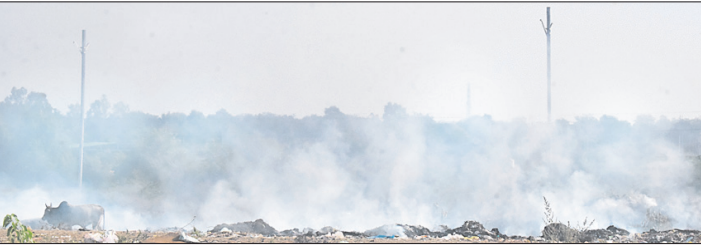
Paryavaran Parisar, a pollution hotspot: According to monitoring data, Paryavaran Parisar
recorded an AQI of 235 on
January 9, followed by a sharp
deterioration the next day.
After touching a very poor level on January 10, the AQI stood
at 285 on January 11, remaining
in the poor category.
On January 12, data recorded
till 4 pm showed an AQI of 201,
suggesting only marginal
improvement. PM2.5 remained
the prominent pollutant on all
these days.
With four days of poor to very
poor air quality within a single
week, Paryavaran Parisar has
clearly turned into a pollution
hotspot, even as other monitoring stations such as TT Nagar
and the Collectorate have largely remained in the moderate category during the same period.
Several factors are at play: Earlier
in the month, Bhopal had already
witnessed a pollution spike during the New Year period. On
January 1, AQI readings touched
278 at Paryavaran Parisar, 264 at
the Collectorate, and 273 at TT
Nagar, pushing air quality into
the poor category across the city.
Similar conditions persisted on
January 2 and 3.
Explaining the
reasons behind the rise, MPPCB
Regional Officer Brajesh Sharma
had said that increased vehicular movement, construction
activity along with other conventional factors, significantly
contribute to higher emissions.
He also pointed out that winter-specific conditions such as low
wind speed and temperature
inversion trap pollutants close to
the ground, preventing their dispersion and causing AQI levels
to rise.
A long-term risk for health:
Health experts warn that prolonged exposure to PM2.5- fine
particulate matter small enough
to penetrate deep into the lungs
and enter the bloodstream- can
have serious health consequences. Continuous inhalation
of these particles can cause respiratory discomfort such as
coughing, wheezing, and shortness of breath, while also triggering eye irritation, throat infections, and headaches.
Over time, sustained exposure
significantly increases the risk of
chronic respiratory ailments like
asthma and bronchitis, and can
aggravate existing heart conditions, leading to a higher likelihood of cardiovascular diseases.
Children, the elderly, and
people with pre-existing lung or
heart problems are considered
especially vulnerable during
periods of elevated PM2.5 levels. To address the issue, pollution control authorities have
stressed the need for immediate
mitigation measures. These
include regular water sprinkling
on roads to suppress dust, strict
and frequent checking of
Pollution Under Control (PUC)
certificates of vehicles, and
better traffic management to
reduce congestion-related
emissions. Civic efforts under
scrutiny as AQI stays poor:
Despite the Bhopal Municipal
Corporation (BMC) claiming
to have intensified pollution control efforts, including regular water sprinkling on major
roads, air quality levels across
the city have shown little sign
of improvement.
Officials
maintain that sprinkling operations are being carried out as
part of routine winter mitigation measures, especially in
areas prone to high vehicular
movement and road dust.
However, the continued poor
to very poor AQI readings, particularly at Paryavaran Parisar,
suggest that these measures
have so far failed to deliver
tangible relief on the ground.
Irregular implementation of
the mitigation measures:
Meanwhile, residents and daily commuters in several localities have raised concerns over
the effectiveness and consistency of these interventions.
Locals claim that while water
sprinkling and other mitigation steps are occasionally visible, they are not conducted
on a regular or sustained basis.
Many allege that sprinkling is
often limited to specific
stretches and times of the day,
leaving large areas uncovered
and allowing dust to resettle
quickly.
Environmental observers
also point out that irregular
implementation of measures
such as dust suppression and
enforcement of pollution
norms could be contributing
to the continued high AQI
trend. They stress that without consistent, city-wide execution of mitigation efforts,
short-term actions by the civic
body may have little impact
on improving air quality.