‘50% of defence production should come through pvt sector’
19 Jan 2026 12:45:03
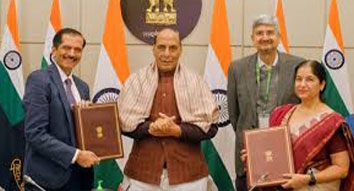
HIGHLIGHTING the rapidly growing presence of private players in
various fields, Defence Minister
Rajnath Singh on Sunday said at
least 50 percent of the country’s
total defence production should
come through the private sector.
He was expressing his views at the
inaugural function of Solar Defence
and Aerospace Limited’s (SDAL)
state-of-the-art Medium Calibre
Ammunition Manufacturing
Facility at Bazargaon.
Maharashtra Revenue Minister
Chandrashekhar Bawankule; former MP Ajay Sancheti; Defence
Secretary Rajesh Kumar Singh;
Chairman of Solar Industries
Satyanarayan Nuwal; Chief
Executive Officer and Managing
Director of the company Manish
Nuwal; and others were also present on the occasion.
Rajnath Singh said, “The nature
of warfare has changed significantly
in the current scenario. Wars are
no longer fought only on borders.In fact trade, energy, supply chains,
technology, and information have
become new dimensions of conflict between countries.
Despite
these changes, our country has
remained firm on key parameters
such asdefence,weapons,and
defence manufacturing.Thisis
possible because of the growing participation of the private
sector,” Rajnath Singh said.
“We want the role of private
players in all sectors to increase
further in the coming days. To
achieve this, our Government
is taking all possible steps,” he
said.
Defence Minister Rajnath
Singh also highlighted that the
country’s domestic defence
production surged from
approximately Rs 46,000 crore
in 2014 tooverRs 1.5lakhcrore
recently, with the private sector contributing nearly Rs
30,000 crore, highlighting a
major shift towards
‘Aatmanirbhar Bharat’ in
defence manufacturing.
Rajnath Singh pointed out
that India has a unique and
effective combination of public and private players in
defence production.
“On one
hand, we have a well-established and experienced public
sector,whileon the other hand,
there are rapidly growing large
private players.This balance is
rare in the world,” he said,
underlining that the
Government is leaving nostone
unturned to further strengthen this combination.
Rajnath Singh further noted
Solar Group’s ongoing development of the Bhargavastra
anti-drone system—a micromissile-based hard-kill solution that has already undergone successful test launches.
He also commended the
Pinaka rocket system, now
being manufactured at the
facility and exported, with
induction into the Indian Army
planned in the coming days.
Medium-calibre ammunition
(23 mm to 40 mm class) forms
the backbone ofinfantry combat, armoured vehicles, naval
gun systems, and aircraftmounted cannons.
Currently, a significant proportion of these critical munitions is imported, exposing
India to risks from export controls, geopolitical uncertainties, and logistics disruptions.
To address this vulnerability,
Solar Group has established a
fully automated, state-of-theart manufacturing facility for
100 per cent indigenous 23
mm, 30 mm, and 40 mm
ammunition.
The company has also set
up a fully instrumented inhouse firing test range for
dynamic evaluation of 30 mm
ammunition and 40 mm
grenades, with a dedicated
range for 23 mm ammunition
slated to become operational
within the next three months.
Duringhis visit, the Defence
Minister lauded Solar Group’s
Pinaka Rocket Integration
Facility for Pinaka ADM-1,
Pinaka ADM-2, Pinaka
Extended Range, and Pinaka
Guided variants.
On the occasion, he and the
Defence Secretary flagged off
a consignment of Pinaka
Guided Rockets. In alignment
with modern battlefield
requirements,Solar Group has
expanded its defence portfolio to include landmines, warheads, missiles, universal airbombs, and weaponised
drones as force multipliers.
The company successfully
developed and delivered India’s
first indigenous loitering munition, Nagastra-1, to the Indian
Army. Advanced variants -
Nagastra-2 and Nagastra-3 -
are in the final stages of development. Solar is also advancing the Bhargavastra hard-kill
system based on micro-missiles.
Further strengthening its
unmanned systems capabilities,Solar Group has launched
a major programme for
Medium Altitude Long
Endurance (MALE) and High
Altitude Long Endurance
(HALE) class UAVs for surveillance and combatroles.To support in-house testing of these
large platforms, the company
has constructed a 1.25km-long
dedicated runway for take-off
and landing operations.