Tiger relocated from Kanha to Nauradehi Tiger Reserve
19 Jan 2026 13:10:20
Staff Reporter:
IN A significant step towards
strengthening wildlife conservation in Madhya Pradesh, a
tiger was safely relocated from
Kanha Tiger Reserve to
Veerangana Durgavati Tiger
Reserve (Nauradehi).
The tiger was originally rescued from the Rukhad Range
of Pench Tiger Reserve in Seoni
district when it was just four
to five months old. Following
the rescue, the cub was
brought to Kanha Tiger
Reserve, where it was raised at
Ghorela re-wilding enclosure
in Mukki. There, it was trained
for independent life in the wild,
including developing natural
hunting skills and free-ranging behaviour.
Now aged around 33 to 35
months, the tiger has been
declared fully healthy and fit for
independent survival in the forest. Based on expert recommendations, authorities decided to release the tiger in a protected area with low tiger density and adequate habitat availability, making Veerangana Durgavati Tiger Reserve a suitable site for its long-term conservation.
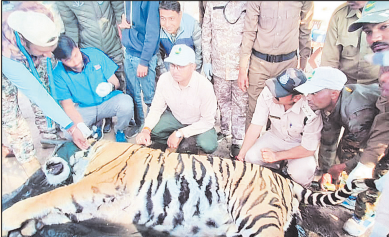
Prior to relocation, the tiger
was sedated by wildlife veterinarians and all essential biological parameters were carefully recorded.
After obtaining
due permission from the competent authority under Section
11(1)(a) of the Wildlife
(Protection) Act, 1972, the animal was fitted with a satellite
radio collar and transported
under continuous expert
supervision, strictly following
prescribed protocols.
Forest officials said the habitat in Veerangana Durgavati
Tiger Reserve offers favourable
natural conditions for the tiger
to establish its territory and
move freely.
The entire operation was carried out under the guidance of
Ravindra Mani Tripathi (IFS),
Field Director, Kanha Tiger
Reserve.
Key roles were played
by Puneet Goyal (IFS), Deputy
Director (Core), Amitha KB
(IFS), Deputy Director (Buffer),
Dr Sandeep Agrawal, Wildlife
Veterinarian, Ajinkya
Deshmukh, Field Biologist, Dr
Aniruddha Majumdar from
State Forest Research Institute,
Jabalpur, Rohan Desai from the
Wildlife Institute of India, along
with other experts, officers and
field staff.
Officials said the relocation
would help enhance tiger presence in under-populated
reserves while ensuring the
long-term survival of the
species.