Water seepage at Manish Nagar underpass still overlooked
02 Jan 2026 12:49:07
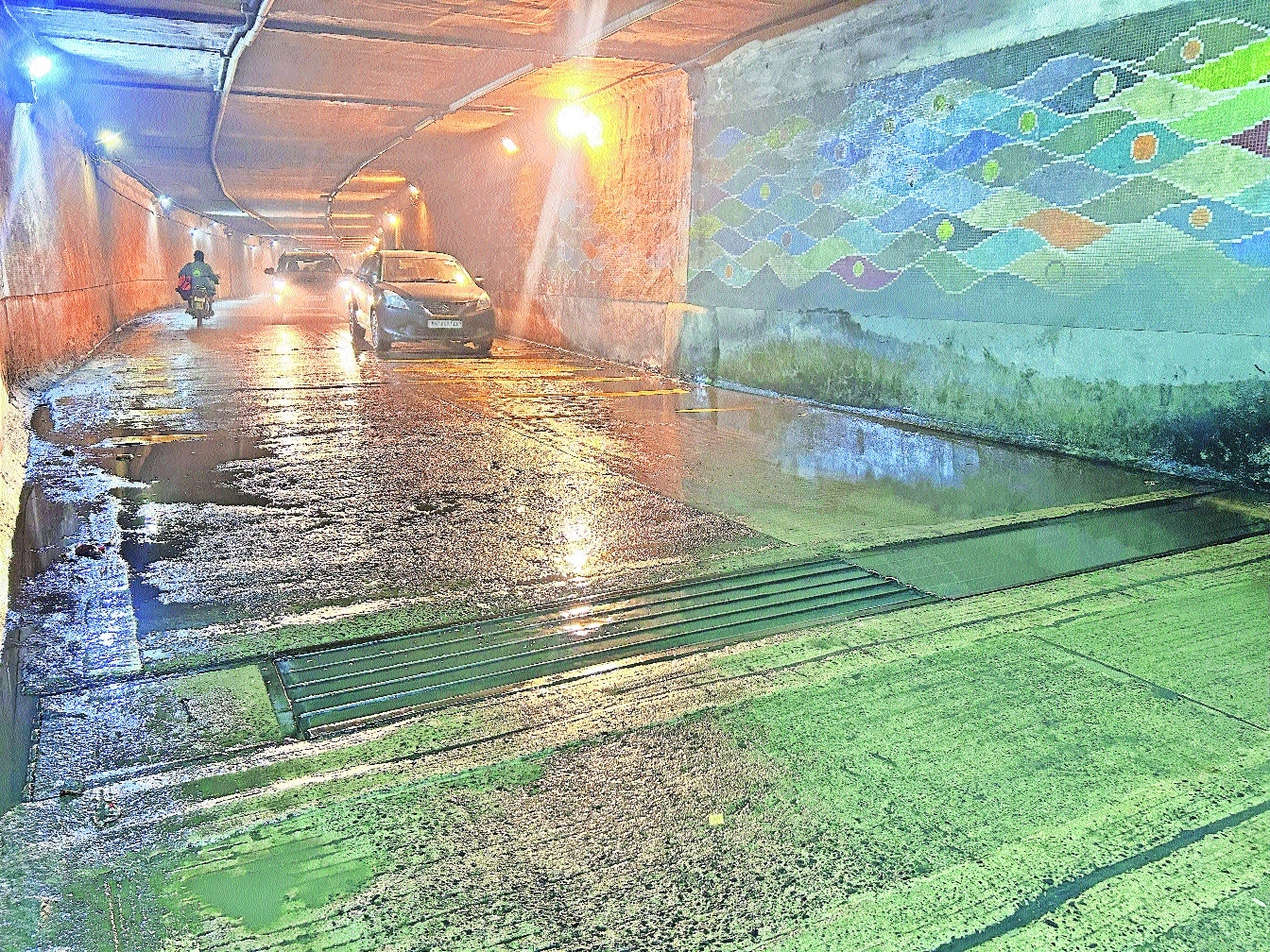
The water that has seeped through the sewer line onto the road.
By Shashwat Bhuskute :
In a city of expertise and power, why is dysfunction normalised?
For over two weeks, the Manish Nagar underpass has stood as an uncomfortable metaphor for urban governance in the city. The discussion so far has centered on sewage overflow, slippery roads and daily inconvenience. But the larger issue lies elsewhere. This is not merely about water on an underpass road; it is about how easily systemic failure is absorbed into everyday life, without answers, ownership or urgency. Contd from page 1
Nagpur is not short of knowledge or capability. It hosts nationally respected institutions that specialise in engineering, environment and urban systems. It has produced political leaders of national standing such as Chief Minister Devendra Fadnavis and Union Minister Nitin Gadkari, both closely associated with the narrative of infrastructure led development.
And yet, a critical urban structure can malfunction for days without a clear explanation, timeline or public accountability.
The unanswered question is not where the sewage came from, but how such failure was possible at all. Was the underpass designed without accounting for sewer load and pressure? Were pipelines allowed to pass overhead without adequate safeguards? Was maintenance reactive rather than preventive? Each possibility points to a deeper trouble, projects are built to be inaugurated, not endured.
According to Sudhanshu Mohod, a Civil Engineer and water proofing expert, “the underpass is one of the busiest passage that connects South Nagpur to Western part of Nagpur, a passage that is busy round the clock.
The leaks are quiet common in patches around the year, a damaged pipeline or seepage through the sewage cannot be ruled out. Many citizens have complained to the authorities but we rarely see any immediate action to resolve the issue.
The Nagpur Municipal Corporation (NMC) is tasked with maintenance. But if the problem stems from flawed construction or compromised design, maintenance becomes a convenient shield rather than a solution. In such cases, citizens are left trapped between agencies, contractors and departments, each pointing elsewhere while the risk remains firmly in place.
This is where the real danger lies. Not in slime on asphalt, but in a civic culture that treats infrastructure breakdown as episodic inconvenience instead of structural failure.
When poor design, weak supervision and delayed response become routine, hazards stop provoking outrage and start being tolerated.
The Manish Nagar underpass forces an uncomfortable reflection. If a basic urban structure cannot be made resilient, inspected proactively and repaired swiftly, what does that say about larger promises of smart cities, world-class roads and sustainable growth?
The question Nagpur must ask is not why this underpass failed, but why failure carries so little consequence. Until accountability is designed as carefully as infrastructure, such episodes will keep resurfacing, quietly reminding citizens that neglect, not scarcity, is the city’s biggest civic problem.
Will neglect become a ballot issue?
With Nagpur heading into long-due civic elections, failures like the Manish Nagar underpass acquires a political meaning. Voters are not just choosing corporators, they are judging years of oversight, design approvals and maintenance priorities. The civic election will test whether everyday infrastructure breakdowns finally translate into electoral accountability, or remain background noise in city politics.