Rare idols of Brahmalie neglected in Bastardespite unique historical value
21 Jan 2026 16:36:14
Our Correspondent :
CONTRARY to the widespread belief in
India that Lord Brahma has only one
temple at Pushkar in Rajasthan, the Bastar
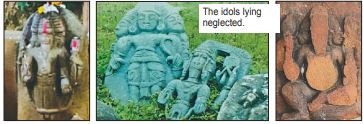
region shelters four rare idols of the
cosmic creator. These artifacts, of
immense historical, cultural, and archaeological value, lie neglected in the open,
with only one damaged idol shifted to
the district museum.
The rest remain exposed at sites like
Mirtur and Mustlanar, fueling local fears
of theft amid rising incidents of ancient
sculpture smuggling in Bastar. Mythology
holds that temples to Brahma invite misfortune, explaining the scarcity beyond
Pushkar. This makes Bastar’s idols exceptionally significant, demanding urgent
scholarly and administrative action.
In Mirtur’s forested area, 12th-century idols of Brahma, Vishnu, and Mahesh
sit unprotected under a banyan tree,
earning the site the local name “Brahma
temple.” Antisocial elements have already
damaged the Shiva idol here, underscoring the lack of security.
Another 12th13th century Brahma idol, found in a
Bastar village, was vandalized losing its
head before being moved to the district
archaeological museum, the only one
under institutional care.
At Mustlanar village on the Indravati
River in Dantewada district, two more
Brahma idols, alongside others, lie in an
open field. Villagers worship them as village deities, yet they are absent from
archaeology department records.
Residents urge the district administration and archaeology department to
collaborate on conservation, warning
that without swift measures, these treasures could vanish like other stolen Bastar
artifacts. Retired archaeology officer SK
Raikwar called Bastar a “treasure trove”
of ancient sculptures, stressing that inaction risks erasing the region’s heritage.
Dr J R Bhagat, Deputy Director of the
Department of Culture and Archaeology,
confirmed widespread thefts but noted
challenges like locals view many idols as
sacred village deities and resist relocation. The Government is now exploring
in-situ preservation plans to protect them
on-site.