Centre notifies new Solid Waste Management Rules, 2026; to come into effect from April 1
30 Jan 2026 12:49:29
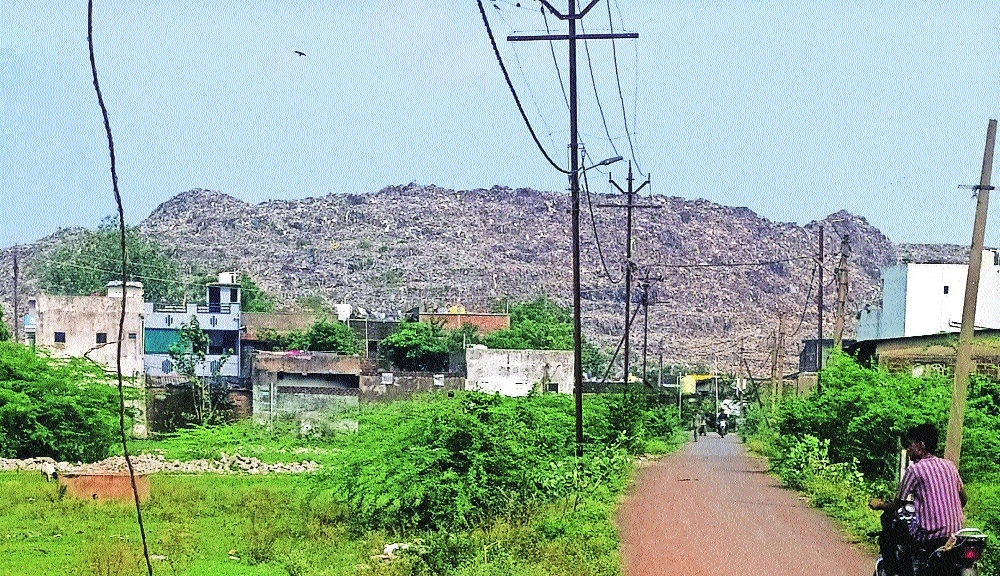
The mountain of legacy waste at Bhandewadi Dumping Yard. (File photo)
- Local bodies and bulk solid waste generators will have to follow the new stricter solid waste management rules
- Four types of mandatory segregation at source – wet waste, dry waste, sanitary waste and special care waste – have been defined in the new rule
- Bulk generators must ensure that waste is collected, transported and processed in environmentally sound manner
Staff Reporter :
The Government of India has taken an important step towards sustainable urban
|living by updating its solid waste management framework. From April 1, urban
and rural local bodies and
bulk solid waste generators will have to follow stricter solid waste management rules, which will replace the existing decade-old regime to collect, segregate and manage garbage in the country. Ministry of Environment, Forest and Climate Change (MoEF&CC) notified the Solid Waste Management (SWM) Rules, 2026, on Tuesday to give effect to this new framework. MoEF&CC informed this in a reply in Lok Sabha.
Four streams of mandatory segregation at source – wet waste, dry waste, sanitary waste and special care waste – have been defined in the new rule.
Citizens, bulk waste generators, and institutions must now segregate waste into biodegradable, recyclable, domestic hazardous, and sanitary/inert waste.
This step is expected to significantly improve recycling efficiency, reduce contamination of waste streams, and lower the burden on processing and disposal facilities of urban and rural local bodies.
As per the new rule, bulk waste generators include entities with a floor area of 20,000 square metres or more, or water consumption of 40,000 litres per day or more, or solid waste generation of 100 kg per day or more. These include Central and State Government departments, local bodies, public sector undertakings, institutions, commercial establishments and residential societies among others.
Bulk generators must ensure that the waste generated by them is collected, transported and processed in an environmentally sound manner. This provision is expected to reduce the burden on urban local bodies and promote decentralised waste management.
The new Solid Waste Management Rules, places larger onus on bulk generators and sets stringent onus on bulk generators – which account for 30 per cent of waste – to process solid waste at source.
Bulk waste generators are required to process wet waste on-site, as far as possible or obtain an extended bulk waste generator responsibility certificate where on-site processing is not feasible.
The rules also strengthen restrictions on landfilling and address the remediation of legacy waste dumpsites. Landfills have been strictly restricted to non-recyclable, non-energy recoverable waste and inert material. It also recommended higher landfill fees for local bodies for sending unsegregated waste to sanitary landfills.
It also mandates mapping and assessment of all legacy waste dumpsites and provides for time-bound biomining and bioremediation.
The new rules broaden the scope of responsibilities, increase linkages for reuse of waste as fuel in boilers, cement kilns, to promote circular economy, and introduces clear penalties for non-compliance.
State clears Rs 30.25 crore for Legacy
Waste Remediation under SBM 2.0
The fund utilisation will be for biomining of
5.5 lakh MT legacy waste at Bhandewadi
Staff Reporter :
The Ministry of Urban Development, Government of Maharashtra gave administrative approval for release of Rs 30.25 crore fund for Legacy Waste Remediation (LWR) to Nagpur Municipal Corporation (NMC) under Swachh Bharat Mission 2.0 (SBM 2.0) initiative recently.
The Ministry gave the approval during the 20th State-level Technical Committee meeting held last year in October and the Government Resolution (GR) released recently.
As per the approval, out of Rs 30.25 crore, Central Government will provide Rs 7.56 crore, State Government
will give Rs 10.58 crore and remaining Rs 12.10 crore fund will be catered by the local body. The fund will be utilised for biomining of 5.50 lakh Metric Ton of legacy waste of Nagpur city.
The fund utilisation will be done quickly by e-tendering of process and the technical aspects will be carried out by the local body. The civic body will follow all norms of e-tendering process.
Nagpur city has 15 lakh MT of legacy waste in Bhandewadi Dumping Yard in which the biomining of 7.5 lakh MT garbage has already been done, whereas the remaining biomining process will be carried out with utilisation of this fund, informed Rajesh Dupare, Executive Engineer, NMC to ‘The Hitavada’.