Indian researcher’s study in US journal reports rare scaleless snake from Nagpur
| Date :30-Jan-2026 |
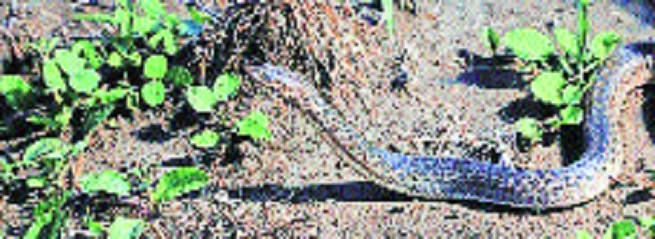
A merolepid (partially scaleless) Checkered Keelback (Fowlea piscator) rescued from a residence in Niranjan Nagar, Nagpur. (Pic courtesy: Santosh Soni & Gaju Patle)
Staff Reporter :
- First Indian case of Merolepidosis in Checkered Keelback
- Discovery highlights possible link between pollution and genetic abnormalities
A rare congenital abnormality in a commonly found Indian snake species has been documented from Nagpur, raising concerns about the environmental factors affecting urban wildlife. A Checkered Keelback (Fowlea piscator), rescued from a residence in Niranjan Nagar, was found to be partially scaleless, a condition known as ‘merolepidosis’.
The case has been formally reported by snake researcher and ophiologist Rahul Shinde of Solapur in the peer-reviewed journal ‘Reptiles and Amphibians’, published by the University of Kansas, USA, on January 26 2026. This marks the first recorded instance of merolepidosis in a Checkered Keelback from India.
The snake, rescued at about 3.30 pm on July 11, 2024 by rescuers Santosh Soni and Gaju Patle, measured roughly 60 cm and showed an almost complete absence of dorsal scales, while its ventral scales appeared normal. Photographs revealed soft, wrinkled skin, indicating disrupted scale formation. Following examination, it was released into a suitable natural habitat. In reptiles, scales are formed by beta-keratin proteins that provide structural strength, prevent desiccation, and protect against abrasion. Any disruption in beta-keratin synthesis due to genetic mutations or environmental stressors can lead to abnormal or missing scales.
Merolepidosis is extremely rare.
India has reported only two earlier cases: Spectacled Cobras from Solapur in 2021 and a Common Trinket Snake from Porbandar in 2023. All were recorded in or near industrialised areas, suggesting potential links to chemical pollutants. International studies have similarly documented deformities in snakes exposed to contaminants.
Shinde notes that abnormalities in a widespread species such as Fowlea piscator should be treated as an early warning for ecosystems in rapidly urbanising regions like Nagpur.