astha karlekar: a custodian of culture
31 Jan 2026 12:33:23
By Aasawari Shenolikar :
Curating any cultural event is no easy task. The challenge becomes manifold when it involves artisans from remote regions of different states - masters of their chosen art forms - bringing them together on a common platform and ensuring their voices are heard. “But since the South Central Zone Cultural Centre (SCZCC) exists precisely to promote and preserve the rich heritage of our folk and tribal traditions, it is imperative that we take this challenge head on,” says Astha Godbole Karlekar, Director, SCZCC.
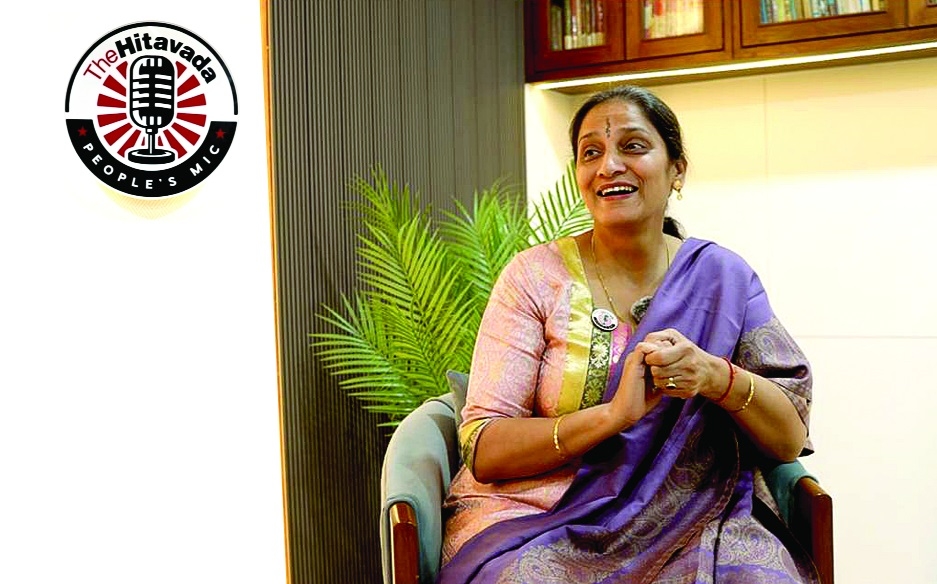
In a candid conversation with Aasawari Shenolikar Deputy Editor & Digital Head, Astha Karlekar, the first woman guest on The Hitavada’s The People’s Mic, takes us through her personal and professional journey, a journey that seamlessly blends culture, management and public administration, at the same time underlining the fundamental role she is playing in propagating India’s
intangible heritage.
Culture, she believes, is deeply ingrained in rituals that we follow daily. “When we light a lamp before a deity in the evening, it is culture - but it is also routine, a daily task. Distinguishing between the two can often be confusing,” she observes, adding that culture is not about merely looking back in reverence.
“It is about taking it forward-with thoughtfulness, inclusivity and purpose.”
Interestingly, this confluence of culture and administration was never a consciously charted career path. “For me it evolved organically,” she reminisces. “I grew up in an environment that was steeped in arts and literature, and I often found myself juggling academics with Kathak, that I was learning from my mother, a trained dancer and performer.”
Learning to balance both from an early age was an advantage, and later when it came to choosing a career path, her father a physician, dissuaded her from following his profession. “He insisted that I excel in my chosen art form - Kathak, and be a beacon in this field,” she says, and she is glad that she listened to his advice.
The turning point in her career came when she had a chance to choose between NSD and College of Theatre Arts, Goa. “I chose Goa, because
I knew I would have had a richer experience - in terms of language as a medium. I wanted to explore something more than Hindi which was NSD’s chosen medium. Goa gave me a chance to learn Konkani, and I added this to my repertoire of languages,” she stated.
Here, theatre broadened her horizons, deepened her love for languages and strengthened her connect with local dialects. Already fluent in Marathi, Hindi and English, she picked up Konkani with ease. Work later took her across the world, and it was during her stint in Tashkent - working directly with the Indian Government-that she began to view culture through a dual lens: that of an artist and an administrator.
“That’s when it became clear what was lacking,” says the administrator, who is proficient in eight languages, including Arabic, German and French.
One concern that deeply troubles her is the gradual distancing of younger generations from traditional crafts. “Globalisation has taken its toll,” she admits. “Children of artisans migrate to cities for better prospects, forgetting that they carry an invaluable asset with them. In the pursuit of the chamak-dhamak of urban life, they leave behind what is truly theirs.”
While she stops short of calling it cultural extinction, she acknowledges that traditional arts are certainly hurting. “If we want to preserve and propagate our rich heritage, we need to pull up our socks.”
Keeping this reality in mind, Astha Karlekar has designed innovative modules that reverse the conventional approach - she takes artisans to the people, rather than expecting audiences to come to them.
“We realised that people were not readily participating in workshops or cultural events that we were curating for them at the SCZCC. So, we focused on building a direct connect between the artist, the craft and the community and started taking the artists to the people.” The response, in schools, colleges, institutions, she says, is heartening.
On the role of social media, she strikes a balanced note. While many youngsters attend performances primarily to make reels, she points out that a significant number remain genuinely engrossed in the artistic renditions. “That itself is a positive sign. And the credit must go to the artists - their appeal and expertise continue to mesmerise and hold attention of the crowd.”
As a woman heading a cultural institution, Astha says she has not faced discrimination in the workplace.
“Perhaps because people see me first as an artist who understands the work she is entrusted with.” She is grateful to her team, “for their unwavering support.” And adds with a smile, “I believe I am a good boss - and that makes all the difference.”
An erosion in our cultural milieu is also, to a certain extent, due to the disintegration of the joint family system.
“Women have been the primary influencers and propagators of our culture. The breakdown of the joint family system and with mothers in nuclear families caught up with various routine things, it is having an adverse impact on child-rearing,” she expresses concern. And stresses that it is the responsibility of both the parents in nuclear families to consciously teach children about our heritage and history.
“Even though mothers are primary influencers, the schools at the secondary level must also play a vital role.”
Quoting the Sanskrit verse -Sahitya sangita kala vihinah, sakshat pasu puccha visana hinah - she reiterates her belief that every individual, irrespective of background, must pursue some form of art.
It was this belief that she grew up with that guided a deeply personal decision when her younger son expressed a desire to become a dancer.
“I laid down the facts before him - the harsh societal biases against male dancers, for I wanted him to understand what he was getting into”, she states.
It was her husband, who offered quiet clarity. “He told our son there were just two conditions: daily riyaaz, and complete indifference to public opinion.
After all, the world’s greatest dancers are Lord Shiva and Lord Krishna.”
Handling six States under SCZCC, Astha insists she plays no favourites, though she confesses to a soft corner for Madhya Pradesh, where she grew up, and Maharashtra, where she married. “But professionally,” she says firmly, “all the states of the country are my babies.”
The conversation touches many more aspects of protecting and conserving our heritage, and on a concluding note, Astha is confident that with the kind of hard work that she is putting into SCZCC, the organisation will be a vanguard of cultural preservation, “Serving as a strong, organic bridge between artists and the common people.”
Her’s is a vision rooted not in nostalgia, but in continuity.
All this and more only on The Hitavada’s YouTube channel @TheHitavada1911. n