City witnesses rare confluence of devotion, culture, research
Date :05-Jan-2026
Staff Reporter:
THE 4th World Ramayana
Conference, organised at Manas
Bhavan in Sanskardhani, concluded with a grand ceremony
marked by a rare confluence of
devotion, culture and research.
The valedictory session was
attended by Bihar Governor Arif
Mohammad Khan as the chief
guest. The conference emerged
as a significant national and
international platform for
Ramayana-based discourse and
reflection.
The closing ceremony started
with the lighting of ceremonial
lamp.
Among those present were
Baba Kalyan Das, Gyaneshwari
Didi, Madhya Pradesh Culture
Minister Dharmendra Singh,
Education Minister Rao Uday
Pratap Singh, Mayor Jagat
Bahadur Singh, organising
President Ajay Vishnoi, Secretary
Dr Akhilesh Gumasta, former
Judge Pankaj Gaur, advocate Ravi
Ranjan, along with scholars,
saints and a large number of citizens.
Addressing the gathering,
Governor Arif Mohammad Khan
said India’s culture is defined not
by discrimination but by the unity of soul, consciousness and
intellect.
He said the divine
resides in every heart, making
every human body a temple and
described spirituality as the true
essence of Indian dharma. He
added that the spirit of oneness
reflected in the life of Lord Ram
is a shared heritage, echoed in
the teachings of Lord Krishna
and sage Kapil.
Quoting a chaupai from
Tulsidas’ Ramcharitmanas, the
Governor explained the importance of satsang and devotion.
He also cited verses from the
Bhagavad Gita, recalling Lord
Krishna’s emphasis on spiritual
dialogue and referred to Adi
Shankaracharya’s composition
“Bhaja Govindam,” highlighting
how satsang leads to detachment, wisdom and ultimately
liberation.
Referring to the Upanishads,
the Governor said true benefit
lies in the company of virtuous
people. Speaking on global conflicts, he observed that while
everyone seeks peace, human
history is filled with bloodshed.
He linked the concept of human
rights to human dignity, noting
that this principle was globally
acknowledged in 1948 and also
embedded in the Indian
Constitution.
Governor Arif Khan emphasised that Indian culture is rooted in respect and harmony. He described Lord Ram as a symbol
of India’s unity and said ancient
scriptures teach that the divine
resides within every individual,
making every human body a temple.
stressed that respect for
every individual and a focus on
oneness are essential to achieving true unity.
Later, Education Minister Rao
Uday Pratap Singh termed listening to the Governor as an
enriching experience and said
Lord Ram’s life offers a moral
blueprint for the younger generation. Expressing views,
Culture Minister Dharmendra
Singh said the Ramayana is not
just a scripture but a foundation
that guides life.
The conference included a
series of research presentations
and intellectual sessions.
Prof
Narendra Kaushik of Jaipur spoke
on the lineage of Lord Ram, while
Prof Abhilasha Singh of
Amarkantak and Ravindra Vajpeyi
presented research papers. Prof
Neelanjana Pathak highlighted
life lessons drawn from sacred flora and fauna mentioned in the
Ramayana. Shailendra Tiwari of
Bhopal discussed the relevance
of sacrifices of Lord Ram and
Goddess Sita for today’s youth.
Dr Ajay Tiwari and Shivakant
Bajpai presented research on the
historical and archaeological
aspects of Ravana, while Dr Parv
Parmar spoke on management
lessons from the Ramayana relevant to young professionals.
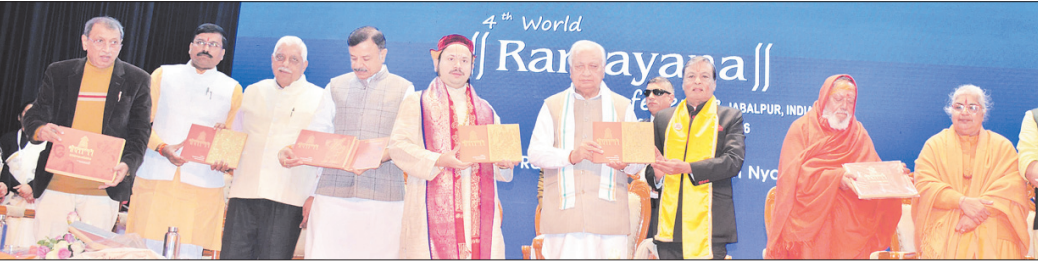
A key highlight of the programme was the release of the
book Shri Ramvallabh, authored
by Acharya Shri Ranchhodlal Ji,
in presence of the Governor,
Baba Kalyan Das and other
saints.
The book offers a philosophical interpretation of Lord
Ram through 108 names,
Sanskrit hymns, Braj verses and
Hindi-English commentary.
Baba Kalyan Das, in his address
said India has always upheld its
cultural values without
encroaching upon others. The
conference concluded on an
emotional note with a
Ramayana-based poetry recital
by poet Sudip Bhola and his team,
followed by Ramleela presentations by the Chhindwara
Ramleela Committee.