Congestion near NSCBMCH gate couldbe a matter of life and death for someone
Date :12-Oct-2026
By Shivanjali Verma :
OUTSIDE the main gates of the
Netaji Subhash Chandra Bose
Medical College and Hospital,
(NSCBMCH) time is measured
not in minutes, but in heartbeats. For families transporting
critically ill patients, every second lost in transit can mean the
difference between survival and
tragedy. Yet, on the bustling arterial road leading directly into the
region’s tertiary healthcare facility, those critical seconds are
routinely consumed by severe
vehicular congestion caused by
unregulated auto-rickshaw
parking outside the entrance.
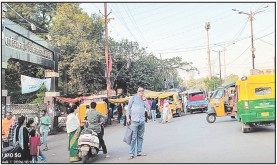
The main entrance to the hospital complex has increasingly
become a bottleneck. Dozens of
auto-rickshaws frequently
assemble along the road shoulders and directly adjacent to the
primary entry point, awaiting
prospective passengers.
Without a designated, structured parking zone or active traffic regulation, vehicles park multiple abreast, effectively reducing the width of the main thoroughfare and creating a persistent gridlock.
The most severe consequence
of this spatial encroachment is
felt by emergency medical services. Ambulances carrying trauma victims, cardiac patients and
individuals requiring immediate intervention frequently find
their sirens drowned out by
localized traffic chaos. Drivers
are forced to maneuver through
narrow gaps created by illegally parked three-wheelers, often
stalling entirely just meters away
from the emergency ward.
“When an ambulance is
forced to stop fifty meters from
the entrance because the passage is obstructed, it is not merely a traffic inconvenience, it is
a direct threat to human life,”
stated Superintendent,
NSCBMCH, Dr Arvind Sharma.
Dr Sharma added that emergency room physicians emphasise that conditions such as
acute respiratory distress, severe
hemorrhage, or cardiac arrest
require immediate triage and
even a three-minute delay outside the gate can severely compromise patient outcomes.
For relatives accompanying
patients, the experience is harrowing. Ambulances and private cars carrying individuals
in critical distress are frequently observed coming to a complete standstill, while driver
efforts to clear a path manually result in heated exchanges
and further delay.
While auto-rickshaws provide
an essential public transit link
for thousands of daily visitors,
patients and healthcare workers who rely on affordable
transportation, the current lack
of organization presents an
unacceptable risk. The Hospital
Administration has repeatedly urged Jabalpur Municipal
Corporation and other authorized departments to institute
structured solutions.
The Corporation and Traffic
Police also took required action
from time-to-time by removing gumtis and stopping
autorickshaws from getting
parked. But after few days,
same situation creates and the
situation becomes uncontrolled during peak hours when
schools get started and closed
down.
Dr Sharma repeated that as
the patient volume at Jabalpur’s
central medical facility continues to rise, addressing the
chaotic conditions at its threshold has become an imperative.
Ensuring clear, unimpeded
access for emergency vehicles
is not merely a matter of urban
traffic management, but a crucial component of public safety and healthcare delivery.