Designed for chaos? Vehicles get too close as adjacent ramps at Ashok Sq choke Indora-Dighori flyover
Date :02-Oct-2026
By Kunal Badge :
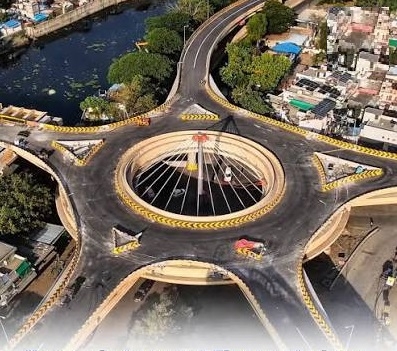
The much-awaited Indora-Dighori flyover, inaugurated amid much fanfare as a solution to traffic congestion across North and East Nagpur, is already showing signs of stress. Barely weeks after opening to traffic, commuters and traffic experts are raising concerns over recurring bottlenecks at Ashok Square rotary, which they attribute to minimal spacing between adjacent entry and exit ramps and movement of heavy vehicles through the junction.
The Rs 998 crore, 8.9-km-long flyover was envisioned as a signal-free corridor connecting Indora and Dighori. However, Ashok Square rotary, where multiple ramps converge, has emerged as a potential choke point during peak hours.
According to traffic experts, the distance between the exit ramp of one arm and the entry ramp of the adjacent arm appears inadequate for smooth traffic movement.
Vehicles exiting the flyover and those attempting to enter it are forced into close interaction within a short stretch, creating conflict points and increasing the risk of side collisions.
The situation becomes more complicated when the city buses and State transport buses negotiate the rotary.
“The turning radius required by a bus is larger than that of a car or two-wheeler. When a bus enters the rotary, it occupies a substantial portion of the carriageway. If another vehicle attempts to merge or enter simultaneously, traffic movement slows dramatically,” said a traffic engineering expert familiar with urban flyover design.
Commuters said even a minor hesitation by drivers can trigger long queues. “During office hours, vehicles begin piling up within minutes.
When a bus struggles to negotiate the turn and motorists try to squeeze through gaps, everything comes to a standstill,” said Prashant Meshram, a daily commuter from Jaripatka.
Another commuter, Ritesh Borkar, said the flyover was meant to eliminate delays but bottlenecks at Ashok Square are defeating that objective. “Heavy vehicles should be restricted during peak hours. The flyover caters to huge volumes of vehicles. One bus moving at a slow pace can affect hundreds of vehicles behind it,” he said.
The concerns add to a series of issues already reported on the newly opened structure. Earlier, commuters complained of inadequate signage at ramps near Daga Memorial Hospital, where the absence of clear ‘No Entry’ boards led motorists to drive against traffic. Directional confusion at Ashok Square rotary had also forced authorities to promise additional signboards.
Experts have now recommended enhanced reflective radium markings on curves, exits and ramp approaches to improve night-time visibility. They warned that the complex geometry of the rotary requires clear visual guidance, particularly for first-time users.
The flyover also came under scrutiny during the first spell of heavy rain after inauguration. Water cascading from elevated sections near Agrasen Square, Panchpaoli and other locations created waterfall-like scenes, prompting questions about the effectiveness of the drainage system and the quality of execution.
With traffic volumes expected to rise further after the festive season, commuters say corrective measures cannot wait. Otherwise, a project designed to ease congestion risks becomes a congestion point itself.