IGGMC Pain Clinic turns a new page in pain relief management for patients
| Date :22-Oct-2026 |
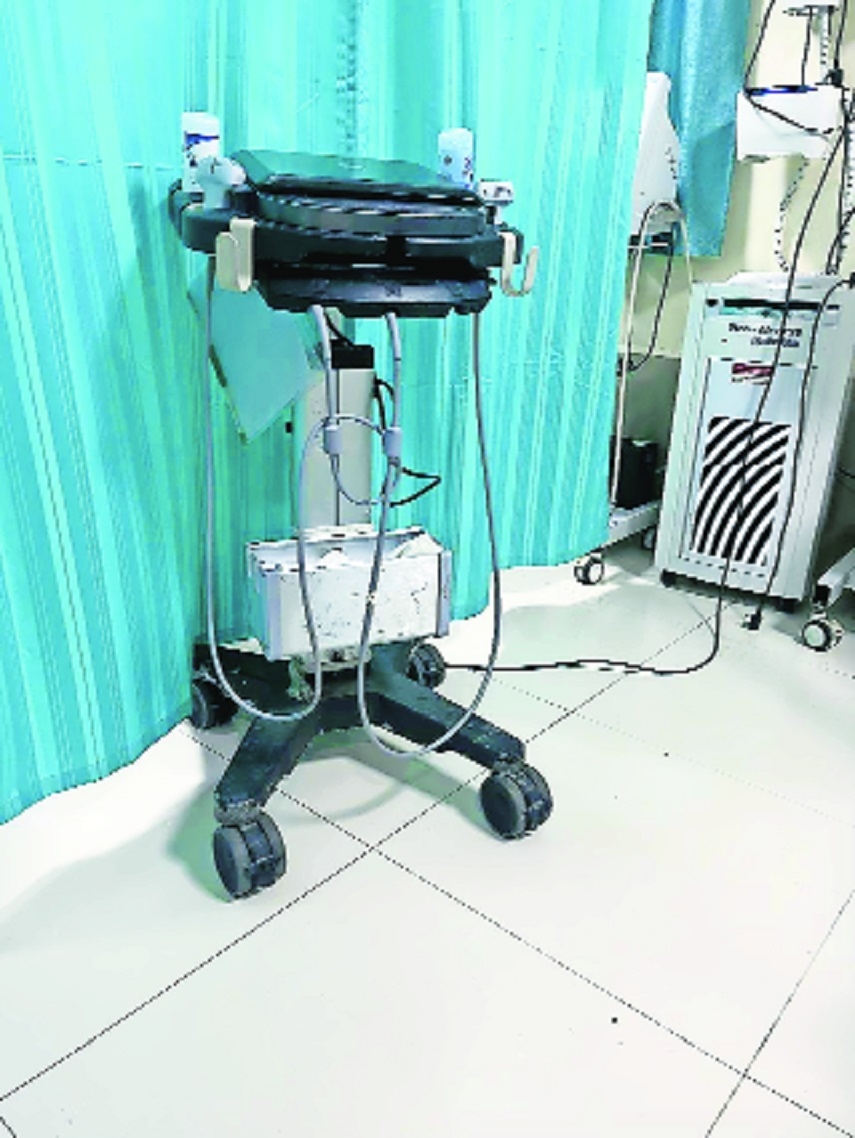
Ultrasonography machine with multiple probes at IGGMCH.
By Saniya Chakraborty :
Advanced imaging and specialised equipment will help doctors locate the source of pain
accurately and perform targeted procedures
Continuing its trajectory in inducting high end medical equipments, the Mayo Hospital in its Diamond Jubilee year is taking patient care to a new domain through induction of advanced machinery.
With this step, patients suffering from chronic pain, persistent back pain, sciatica, nerve compression and cancer-related pain may soon find relief as the Mayo Hospital has launched the Pain Clinic under the Diamond Jubilee year of the hospital.
The clinic, which was launched in August, aims to reduce the painful experience suffered by patients and identify the precise nerve or area responsible for pain and treat its root cause while minimising damage to surrounding tissue.
Advanced imaging and specialised equipment will help
doctors locate the source of pain accurately and perform targeted procedures, offering patients
an alternative when conventional treatment fails to provide
adequate relief.
Dr Vaishali Shelgaonkar, Professor and Head of the Department (HOD) of Anesthesiology, IGGMCH, said the treatment begins at the Pain OPD, where doctors assess patients’ medical histories, including previous accidents, trauma, surgeries, spinal injuries, cancer and postural defects. Patients are counselled and undergo basic investigations, while CT scans or MRI examinations are recommended wherever necessary.
“Based on the assessment, patients are scheduled for procedures in a dedicated room attached to the operation theatre or in the Pain OT. Specialised needles are inserted through the skin, with their placement guided by a C-arm imaging system or ultrasonography (USG),” explained Dr Shelgaonkar.
The procedure allows doctors to visualise the target area and position the needles accurately. Depending on the condition, local anesthesia or phenol may be injected to block pain signals. Cooled radio frequency technology can also treat the problematic area while limiting damage to surrounding tissue. Physiotherapy may be advised after the procedure to support recovery and improve mobility, she explained.
Training is also being provided by experts to help doctors use the specialised equipment and perform procedures safely. The clinic will cater to patients with chronic back pain, disc prolapse, trigeminal neuralgia and other neuropathic conditions.
It may also help manage persistent pain following limb amputation and pain associated with kidney, pancreatic and ovarian cancers. The available equipment the clinic currently has includes an anesthesia workstation and multipara monitor, C-arm image intensifier, peripheral nerve locator and mapper, and an ultrasonography machine with musculoskeletal probes.
A high-end workstation, cooled radio frequency machine, advanced ultrasonography machines and a specialised procedure table are expected within the next one to two months, further strengthening the clinic’s treatment capabilities.