Indian chronology offers golden opportunity for researchers, says Dr Atul Vaidya at KKSU event
| Date :27-Oct-2026 |
Business Reporter :
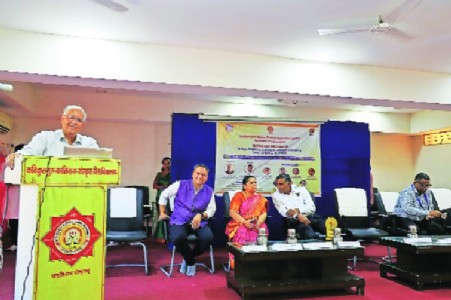
21-Day Jyotirvigyan Workshop concludes at Kavikulaguru Kalidas Sanskrit University
The 21-day Jyotirvigyan (astronomical sciences) workshop organised by the Department of Vedanga Jyotisha at Kavikulaguru Kalidas Sanskrit University (KKSU), Ramtek, concluded on Monday. The primary objective of the workshop was to familiarize students with the fundamental concepts of Vedanga Jyotisha, its diverse applications, and the significance of the Indian system of time-reckoning.
Captain Harsha Korelarachchi from Sri Lanka attended the valedictory session as the chief guest.
The session was presided over by the Vice-Chancellor Dr Atul Vaidya. Registrar Dr Roshan Alone, Dean Prof. Lalita Chandratre, Prof. Kavita Hole, Prof. Harekrishna Agasti, and workshop coordinator Prof. Prasad Gokhale were prominently present on the dais.
In his introductory remarks, Prof. Prasad Gokhale, the workshop coordinator, stated that a total of 55 students had successfully completed the 21-day workshop.
Captain Harsha Korelarachchi observed that the message conveyed by the great poet Kalidasa could be viewed as an example of the concept of a cloud messenger. Drawing a parallel between the cloud as a medium for storing information and air as a means of transmitting messages, he remarked that Kalidasa had explored this idea through his poetic imagination nearly two thousand years ago. Today, similar concepts are reflected in modern communication technologies that facilitate the sending and receiving of messages.
Telephone calls, email, and video conferencing are contemporary examples of such communication. In his presidential address, Dr Atul Vaidya stated that Jyotisha is both a science and a systematic discipline, but its study also requires a spiritual foundation and purity of mind. He emphasized that the Indian system of time-reckoning offers a golden opportunity for researchers. Anuj Sharma conducted the programme, while Dr Ambalika Sethia proposed the vote of thanks.