Contemplating policy framework to tackle child pornography: Govt
| Date :28-Oct-2026 |
NEW DELHI :
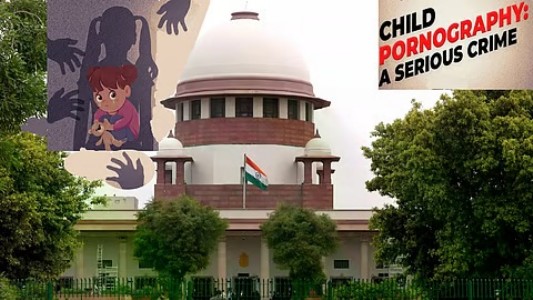
THE Centre told the Supreme
Court on Tuesday that it was contemplating a policy framework
to tackle the menace of child
pornography and circulation of
non-consensual explicit content
involving adults.
Solicitor General Tushar Mehta
told a bench of Chief Justice of
India (CJI) Surya Kant and
Justices Joymalya Bagchi and V
Mohana that the bill might
extend to imposing liability on
intermediaries not just to take
down offensive content, but also
to apprise authorities about the
uploading of the content.
He told the top court that the
policy framework might provide
for bona fide complaints by third
parties, not just the affected person. “A statutory legislative mechanism is also under contemplation. I cannot say more until it
comes before Parliament,” Mehta
said. During the hearing, senior
advocate Aparna Bhat, appearing for NGO Prajwala, apprised
the court about the absence of
adequate safeguards for adults
and the circulation of sexual
assault videos.
“Explicit videos involving
adults are being transmitted.
There was a mechanism established pursuant to an earlier
order of this Court, but that
mechanism is now dysfunctional.
“One aspect concerns pornography, but the other issue concerns non-consensual intimate
images and videos, including
videos of sexual assault. There
are two categories,” she said.
Mehta told the court that suggestions would be invited from
all stakeholders. “In fact, subject
to the bill passing through the
legislative process, there may be
a provision that the moment such
material comes to the notice of
an intermediary, it must not only
be taken down, but the intermediary should also inform the
police that somebody has
uploaded it,” Mehta said.
The top court said it
would like a policy
regime in the matter to
control this menace. The
apex court was hearing
Prajwala’s plea concerning the circulation of
non-consensual intimate images and videos,
including videos of sexual
assault. The bench also
adjourned for four weeks the
hearing on a plea seeking a ban
on streaming of sexually explicit content on OTT and social
media platforms. The plea filed
by five petitioners sought guidelines to constitute an authority
to prohibit online dissemination
of obscene content.