CAG exposes DMF cracks: Rs 4,870 cr unbudgeted
| Date :08-Oct-2026 |
RAIPUR :
A COMPTROLLER and Auditor
General (CAG) performance
audit has exposed systemic
deficiencies in Chhattisgarh’s
District Mineral Foundation
(DMF) regime, revealing that
Rs 4,870.19 crore was utilised
in 12 sampled districts
without annual plans and
budgets, while hundreds of
villages directly affected by
mining remained outside the
welfare net.
‘The Hitavada’ has accessed
and meticulously examined the
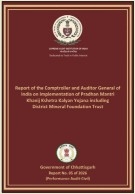
82-page CAG Report No 05 of
2026 on implementation of the
Pradhan Mantri Khanij Kshetra
Kalyan Yojana (PMKKKY),
including District Mineral
Foundation Trusts (DMFTs), in
Chhattisgarh. The performance audit principally covers
2015-16 to 2023-24 and records
findings concerning fund management, beneficiaries, planning, procurement, execution,
monitoring and
accountability.
The findings
assume significance amid continuing investigations by the
Enforcement Directorate (ED)
and State Economic Offences
Investigation and AntiCorruption Bureau (SEOIACB)
into the alleged DMF scam.
The CAG audit neither determines criminal culpability nor
links its individual findings to
transactions under investigation by the agencies.
According to the report,
Chhattisgarh’s DMFTs received
Rs 13,101.65 crore and spent
Rs 10,253.22 crore up to
2023-24. In the 12 sampled districts, Managing Committees
did not prepare mandatory
annual plans
and budgets
and utilised Rs
4,870.19 crore, or 79.18 per cent
of receipts totalling Rs 6,150.42
crore, without a budgetary
framework.
The audit recorded
another significant finding
concerning identification of
beneficiaries. DMFTs in the 12
sampled districts allocated Rs
709.47 crore for beneficiaryoriented schemes and works
without identifying the ‘affected people’ envisaged under
PMKKKY. These included free
distribution of shade-nets,
agricultural tools and implements, personal tube wells,
fishnets and coaching and
tuition assistance. A test-check
of 30 cases involving Rs 28.11
crore found distributions
were made randomly without
stipulated beneficiary-selection criteria.
The CAG further recorded
that Bilaspur and Sukma
authorities reported no ‘directly affected people/families’
under the applicable definition, yet their Trusts allocated
Rs 106.94 crore to implementing agencies for procurement and free distribution of
items among villagers.
The beneficiary gap extended to villages. Despite utilisation of Rs 4,536.58 crore, or 81 per cent of available funds,
754 of 1,734 directly affected villages, representing 44 per
cent, remained uncovered in 11 sampled districts. In Sukma,
Rs 333.61 crore was utilised without identification of directly affected villages. Affected areas themselves were identified five to 65 months after establishment of the Trusts,
while Rs 1,060.70 crore had already been allocated before
such identification.
The spending trail included Rs 41.80 crore termed unfruitful expenditure by the CAG on incomplete works and
unutilised assets, including an Art and Culture Centre, biogas-driven power generation plants and poultry and mushroom production centres. Another Rs 30.73 crore was provided for 80 projects and activities outside PMKKKY priority areas, including welcome gates, Collectorate gardens,
government-office construction or renovation, office purchases, land-record digitisation and promotion of district
administration social-media networks.
Procurement practices also came under scrutiny.
Implementing agencies procured items and services worth
Rs 17.49 crore through limited quotations without open
tenders, while Rs 38.82 crore worth of goods and services
was procured without stipulated technical specifications,
according to the audit.
The report separately flagged movement of DMF money to the State-level DMF Cell. Despite the Government of
India’s July 12, 2021 direction against transferring DMF funds
to a State-level fund, the audit found Rs 1.68 crore was
subsequently transferred by Trusts in Balod, Bilaspur and
Korba. It further recorded that Rs 10.82 crore remained
outstanding with the State-level DMF Cell as of March 2024.
The State Government furnished its explanation, but the
CAG maintained that the outstanding amount had yet to
be returned to the Trusts.
Audit-trail deficiencies were also documented. All 12
sampled DMFTs failed to maintain prescribed registers
and ledgers covering administrative sanctions, fund
releases and utilisation certificates. Records of works and
activities were maintained in editable Excel spreadsheets,
which the CAG described as vulnerable to alteration.
Procurement records produced by implementing agencies
in all 12 districts were kept in loose files, preventing
assurance about their completeness. Korba Trust records
were also maintained in loose files without chronological
organisation.
The findings come against the backdrop of the
separate ED and SEOIACB investigation into alleged irregularities in DMF contracts, including allegations of
commissions and kickbacks. The CAG report does not establish that transactions examined in its performance audit
and those forming part of the criminal investigation
are identical.
The CAG additionally flagged absence of social audits,
inadequate disclosure of information and manpower shortages. Bemetara and Mahasamund recorded 100 per cent
manpower shortage, while shortages exceeded 50 per cent
in Balod, Bilaspur, Raigarh and Rajnandgaon. The audit
period spans successive political administrations. The
report was forwarded to the State Government on June 12,
2025, replies were received on August 22, and an exit conference was held on August 25, 2025. The Government’s
responses were incorporated into the final report.