NASA’s Voyager 1 is now one light-day from Earth
| Date :19-Nov-2026 |
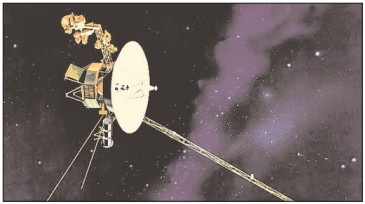
WASHINGTON :
NEARLY five decades after setting
out from Earth, NASA’s Voyager 1
crossed a historic milestone,
becoming the first human-made
object to travel a light-day away
from our planet. The spacecraft
reached the distance on
Wednesday, November 18, at
3:46:07 pm IST, covering approximately 16 billion miles (26 billion
kilometres).
But this is not a milestone measured in time. It is a milestone of
distance. A light-day is the distance
light travels in 24 hours, offering a
measure of just how far humanity’s most distant spacecraft has
ventured into the cosmos.
Launched on September 5, 1977,
Voyager 1 was originally sent to
explore the outer planets of our
solar system. Travelling at nearly
38,000 miles per hour (61,000
kmph), it crossed the heliosphere,
the Sun’s protective bubble of particles and magnetic fields, and
entered interstellar space in 2012.
Its twin, Voyager 2, launched 16 days
earlier, followed it into interstellar
space in 2018.
The two spacecraft transformed
human understanding of Jupiter,
Saturn and their moons, before
continuing towards the unexplored
reaches of space.
Nearly 49 years after launch,
Voyager 1 continues its extraordinary journey, carrying a message
from humanity into the cosmic
unknown as the robotic probe carries a rather unusual piece of cargo. Along with its scientific
instruments, the spacecraft has
a gold-plated record containing greetings, music,
photographs and sounds from
Earth.
It is a message from humanity to anyone who might one
day discover the spacecraft,
offering a glimpse of the planet it came from and the life that
inhabits it.
Called the Golden Record,
the 12-inch gold-plated copper
disc was placed aboard both
Voyager 1 and Voyager 2 before
their launches in 1977. The idea
behind the project was that if
an advanced extraterrestrial
civilisation ever came across
either spacecraft, the record
could offer a way to introduce
humanity.
According to NASA website,
the golden record contains 115
images, a collection of natural
sounds, musical selections
from different parts of the world
and spoken greetings in 55 languages.
The images offer a visual
introduction to Earth and its
inhabitants. They include photographs and illustrations
showing human anatomy,
DNA, childbirth, families, animals, landscapes, buildings,
food and everyday activities.
There are pictures of the Taj
Mahal, the Great Wall of China,
the Sydney Opera House and
the Golden Gate Bridge. Other
images show people working,
eating, dancing and interacting with nature.
The record also carries
sounds such as crashing of
waves, wind, thunder, birds,
whales and other animals.
These are accompanied by a
selection of music from different cultures and periods.
The musical collection
includes compositions by
Bach, Beethoven and Mozart,
alongside traditional music
from Africa, Asia and other
parts of the world. American
musician Chuck Berry’s ‘Johnny
B. Goode’ also features on the
record.