A life lost, NMC awakens: Late-night demolition at Godhani Road
| Date :05-Nov-2026 |
Staff Reporter :
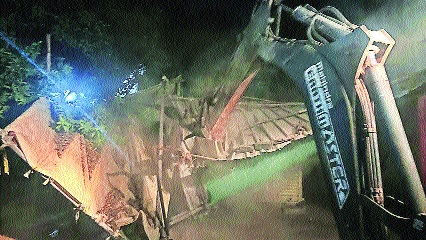
It took the tragic death of a young mother out for festive shopping at Godhani road for the authorities to finally wake-up to need for removal of encroachments, one of the reasons for shrinkage of carriageway. Frustrated with lack of action on part of Nagpur Improvement Trust (NIT), Nagpur Municipal Corporation (NMC) itself conducted the anti-encroachment drive. Hours after Ashwini Phalke was crushed under a tipper truck on the bottlenecked Godhani Road, Tuesday evening, the civic body’s enforcement squad launched an emergency night-time anti-encroachment drive, tearing down illegal commercial extensions. Between 8.30 pm and 11.15 pm, civic enforcement teams deployed JCBs along 18-metre-wide arterial corridor under Mankapur Station Police limits.
Speaking to ‘The Hitavada’, Assistant Municipal Commissioner (Enforcement) Sanjay Kamble revealed that illegal encroachments had severely constricted the thoroughfare. “Though designed as an 18-metre road with a central median, residential property owners converted ground floors into shops and illegally erected sheds over mandatory parking margins. Consequently, customers parked vehicles directly on the main asphalt, squeezing vehicular movement into a hazardous bottleneck,” Kamble said.
During the crackdown, the squad demolished seven to eight unauthorised sheds, including a 600-square-foot illegal structure built entirely over parking space, amidst stiff resistance from local shopkeepers.
“We planned to resume demolition on Wednesday, but as the road fall under the jurisdiction of NIT, co-ordination with them is necessary. Furthermore, Mankapur police has also pleaded for allowing shopkeepers a day’s time to voluntarily dismantle their illegal structures to prevent potential law-and-order disruptions in the area,” said Kamble.
However, the civic administration’s sudden knee-jerk reaction has drawn sharp fury from citizens, who ask why authorities habitually wait for fatal tragedies before enforcing the law.
Encroachment of roads and footpaths is not confined to Godhani; it remains a chronic, pervasive crisis across commercial hubs and suburban arteries in city. From Sitabuldi and Jaripatka to Dharampeth and Zingabai Takli, and not to mentioned Gandhibag and Itwari, the commercial establishments unabatedly usurp walking strips and road margins under the nose of zonal officials.
Proactive, zero-tolerance enforcement across the city is need of the hour rather than post-disaster tokenism. Urban mobility and pedestrian safety cannot remain hostage to administrative inertia until another innocent life is snuffed out on the asphalt.