Ar Avinash Dongre — The passing away of an icon
01 Feb 2026 13:21:31
By Paramjit Singh :
Ahuja
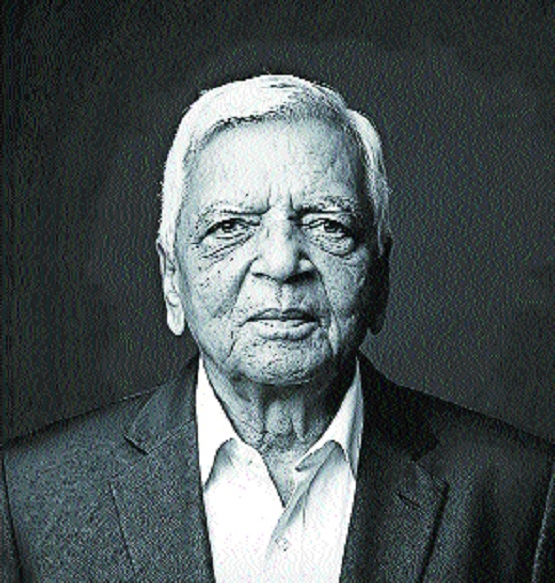
ARCHITECT Avinash Bhalchandra Dongre, one of the most revered architects of Nagpur, passed away on Thursday, January 29. Born on July 2, 1937 in Badwaha, Madhya Pradesh, his life and career spanned several decades of India’s architectural and nation-building journey. He belonged to the generation that came of age soon after Independence — a generation entrusted with the immense responsibility of shaping a new nation through thoughtful planning and purposeful construction.
After independence, at the time of merger of Baroda State with the then Bombay State, his father being an employee with the Maharaja of Baroda, in his Khangi Office (Personal), was uncertain whether he will be absorbed in the Bombay State Services. So as an alternative arrangement, he with one of his friends started a retail kirana shop and flour mill at fourteen years of age. Being the eldest son, he helped the family along with his cousins, in keeping the business running, attending the same after school hours.
He completed his matriculation from M C High School, Baroda, in 1954 (SSC Board, Bombay State) and went on to pursue a Bachelor of Architecture with honours from Kala Bhavan College of Engineering & Architecture, Baroda, graduating in 1959. During his student years, he worked as a junior draftsman on the Kadana Dam Project for the Government of Gujarat. He assisted Prof. Madhav Achawal as a part-time associate in his private practice. In 1958, he gained invaluable exposure as a trainee at the Chandigarh Architect’s Office for the Capitol Complex of Punjab, working under the guidance of Senior Architect Pierre Jeanneret — an experience that deeply influenced his architectural sensibilities.
In 1959, he was appointed Lecturer at the Government Polytechnic, Nagpur, where he served for one academic year before beginning his independent architectural practice in 1960. His practice soon flourished, earning him significant projects across Nagpur and Wardha and establishing him as a respected professional with a distinctive design philosophy.
A committed contributor to the architectural community, he was a past Rotarian and served as Chairman of the Indian Institute of Architects (IIA), Nagpur Centre. He played a pivotal role in the formation of the Architects’ Association, Nagpur (AAN), with its very first meeting being held at his residence in Laxmi Nagar. His work and interview were featured in the inaugural issue of the IIA Nagpur Centre newsletter. In recognition of his professional standing, he also served as a national-level jury member for the J K Awards for Architecture in 2008.
In 1972, he was awarded a prestigious fellowship by the Government of the Netherlands to study at Bouwcentrum, Rotterdam, as part of the International Course in Housing, Planning and Building (ICHPB). This opportunity enabled him to visit and study the architectural heritage and contemporary practices of several European cities, including Paris, London, Brussels, Oslo, Rome, and Copenhagen — broadening his global perspective while strengthening his contextual approach to design.
Among his many notable architectural contributions are the Gandhi Smarak Leprosy Foundation, Wardha, established by the Gandhi Smarak Nidhi under the directorship of Dr. Wadadekar; the Regional Office of the Maharashtra State Cooperative Bank, designed in his twenties and admired for giving the institution a distinct identity along the banks of Gandhi Sagar; and the PP Dr Hedgewar Smruti Bhavan, involving the sensitive remodelling of the 200-year-old residence of the founder of the RSS.
Equally significant was the Peace Centre for NCCI (1975) — a modest, ashram-like structure built with natural clay bricks, exposed concrete, stone floors, timber joinery, and clay roof tiles — an oasis of calm
amidst the city’s bustle, conceived as a space for dialogue beyond faith and national boundaries.
Other major works include the Indian Airlines building (1982–84), a form-finished RCC and brick-clad structure harmoniously aligned with its historic institutional surroundings; environmentally responsive industrial facilities for Mahindra & Mahindra; and numerous educational institutions for Bharatiya Vidya Bhavan, known for their classroom-centric planning, excellent light and ventilation, functional clarity, and climate-responsive design strategies. He also played a crucial role in the design and construction of the Sanskritik Kendra for Bharatiya Vidya Bhavan at Nagpur.
In the year 2016, he was honored with Late Shri Maniklalji Gandhi Smruti Vidarbha Gaurav Puruskar by Krushi Vikas Pratishthan at the hands of the then Governor of Assam, Hon’ble Shri Banwarilalji Purohit.
Whether designing a simple entrance gate or planning a sprawling campus, he approached every project with meticulous attention to detail and unwavering concern for the client’s welfare.
His guiding principles were practicality, simplicity, economy, functional efficiency, and enduring aesthetic quality. For him, architecture was a noble profession — not a business — and quality always took precedence over quantity.
Short in stature yet towering in influence, soft-spoken, approachable, remarkably unassuming,
and ethical to the core, Architect Avinash Bhalchandra Dongre embodied integrity in both
life and practice. He will continue to inspire generations of architects and countless admirers through his work, values, and example.
With the earlier passing of Architect Sheo Dan Mal and now Architect Avinash Bhalchandra Dongre, Central India’s architectural fraternity has lost two of its most cherished icons. May their souls rest in eternal peace at the lotus feet of the Almighty.
(The author is former Chairman, The Indian Institute of Architects, Nagpur Centre.)