BNP secures landslide victory in Desh polls
| Date :14-Feb-2026 |
DHAKA :
- BNP set to return to power after 2 decades and its top leader Tarique Rahman to become PM to replace Yunus-led interim Govt
- BNP bagged 209 seats out of 297 while Jamaat-e-Islami secured 68 seats, Hasina’s Awami League was barred from polls
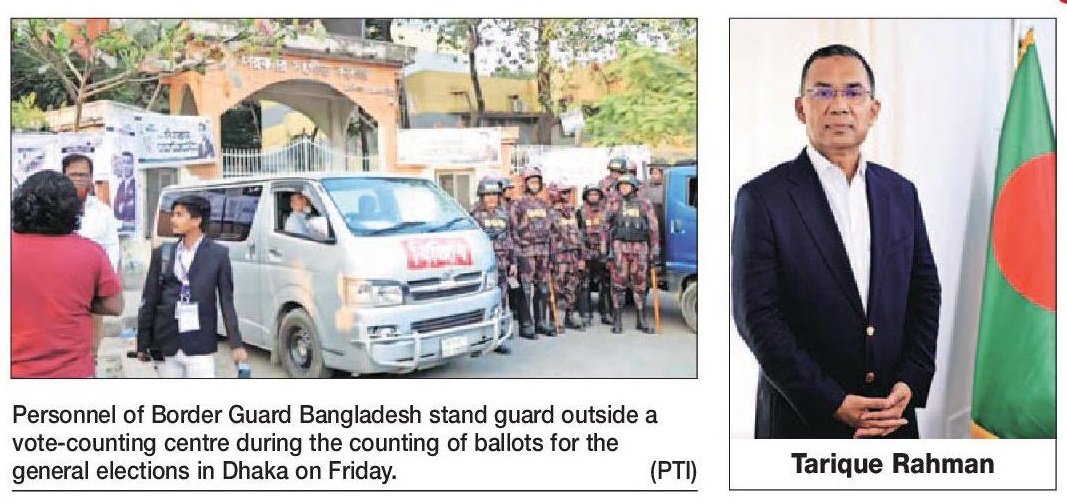
THE Bangladesh Nationalist Party (BNP) on Friday secured a sweeping victory with more than two-thirds majority in the landmark parliamentary elections and is making a spectacular return to power after a gap of two decades.
The 13th Parliamentary elections assumed significance as they were held after a period of tumultuous political vacuum, instability and fragile security situation, including widespread attacks on minorities after the student-led protests brought down the 15-year rule of Sheikh Hasina in August 2024.
According to the unofficial results announced by the Election Commission (EC), the BNP has bagged 209 out of 297 seats, while right-wing Jamaat-e-Islami, known to be close to Pakistan, secured 68 seats. The Awami League party of Hasina was barred from contesting the polls, which recorded 59.44 per cent voter turnout. The EC postponed the announcement of results in two seats - Chattogram-2 and Chattogram-4. The election in one seat was postponed due to the death of a candidate.
BNP’s top leader Tarique Rahman is set to become the Prime Minister for the first time. He will replace the interim Government chief Nobel laureate Muhammad Yunus, under whose tenure Dhaka’s relations with New Delhi witnessed a significant downturn.
The US Embassy in Dhaka has congratulated the people of Bangladesh in advance on what it described as a successful national election, extending special recognition to BNP and Rahman for their “historic victory.”
“The US looks forward to working with you to realise shared goals of prosperity and security for both our countries,” its social media post read.
China and Pakistan also congratulated the BNP chairman on the party’s victory.
The voting for the general election was held on Thursday, along with a referendum on the implementation of a complex 84-point reform package, known as the July National Charter.
According to Election Commission Senior Secretary Akhtar Ahmed, the referendum saw a 60.26 per cent voter turnout, with the “yes” vote winning a clear majority.
The election was seen as a direct contest between the BNP and its former ally, Jamaat-e-Islami, which led an 11-party alliance.
Jamaat’s key ally, the National Citizen Party, formed by the Students Against Discrimination, which led the mass protests against Hasina in August 2024, failed to convert its initial popularity into votes and won just six seats. Islami Andolon Bangladesh won one seat, and independent candidates seven.
BNP was in power earlier between 2001 and 2006 when Jamaat was its crucial partner, with two of its leaders serving as Ministers.
Meanwhile, Jamaat has raised allegations of “abnormal delays” and “result tampering,” warning that it would launch a tough movement if the public mandate were “snatched away”.
Speaking to reporters at the Election Commission building early morning, Jamaat’s assistant secretary general Ahsanul Mahboob Zubair alleged that returning officers were intentionally delaying results to favour a “particular party.”
“In the seats contested by our top leaders, results should have been declared by 8 pm or 9 pm according to the signed sheets given to polling agents,” Zubair said.
The NCP, floated with interim government chief Yunus’ blessings last year, also brought allegations of “result tampering and planned fraud” in multiple Dhaka seats in particular.
The Election Commission dismissed allegations of manipulation regarding voters’ appearances in polling centres.
Election Commissioner Brig Gen (retd) Abul Fazal Md Sanaullah on Friday said the spontaneous and massive participation of people in the election proved that ‘we are ultimately victorious as a nation.’
“We had only one commitment to the nation: to conduct a neutral election. We have tried our best to ensure that. We are deeply grateful to the people of the country, as they participated spontaneously in this massive arrangement. This has proved that we are ultimately victorious as a nation.”
More than 2,000 candidates, including several independents, were in the fray for 299 of the 300 parliamentary constituencies that went to the polls.
The Election Commission made elaborate security arrangements for the elections, deploying nearly 1 million security personnel -- the largest-ever in the country’s electoral history.