Turning rice-fallow into gold: Rapeseed-mustard cultivation may be a game-changer for Chhattisgarh agriculture
| Date :16-Feb-2026 |
Staff Reporter
:
CHHTTISGARH often called the ‘Rice bowl of Central India’ has long relied on Kharif rice as
the backbone of its agricultural economy.
While rice ensures food security and stable income through procurement mechanisms, a large proportion of farmland remains un-cropped after paddy harvest, leading to underutilization of natural resources and reduced income opportunities for farmers.
Transforming these rice fallows into productive farmland by adopting the rapeseed-mustard cultivation offers a remarkable opportunity to enhance farm income, improve cropping intensity, strengthen edible oil security, and promote sustainable agriculture. Sharing his expert views, Joint Director of ICAR–National Institute of Biotic Stress Management (ICAR-NIBSM) Dr Pankaj
Sharma said that among Rabi crops, rapeseed-mustard is emerging as a highly suitable crop for rice fallow systems due to its adaptability, low water requirement, and short duration. In Chhattisgarh, Rabi sowing period from second the fortnight of November to first week of December coincides with cool and congenial winter temperatures ranging from 20-30 °C, which are ideal for rapeseed-mustard growth and development.
It’s short duration of 90–120 days allows it to fit well into depleted post-Kharif fields and offer triple advantage to farmers, with a relatively low cost of cultivation, assured price support through an attractive Minimum Support Price and improving utilization of rice-fallow. Dr Sharma said that the current area under rapeseed-mustard in the state is very low at about 31,000 hectares with a production of 17,260 ton and 563 kg per hectare productivity. Research trials have demonstrated that improved rapeseed-mustard technologies can enhance yield by over 20 per cent compared to traditional farmer practices in rice fallow conditions.
Meanwhile under All India Coordinated Research Project on Rapeseed–Mustard (AICRP-RM), ICAR is focusing on the development and dissemination of high-yielding and disease-resistant varieties and promotion of zero-tillage technologies suitable for rice-fallow areas. Different varieties suitable for Chhattisgarh were developed like DRMR 150-35, NRCHB-101, Chhattisgarh Sarson, TBM-209 and BBM-1.
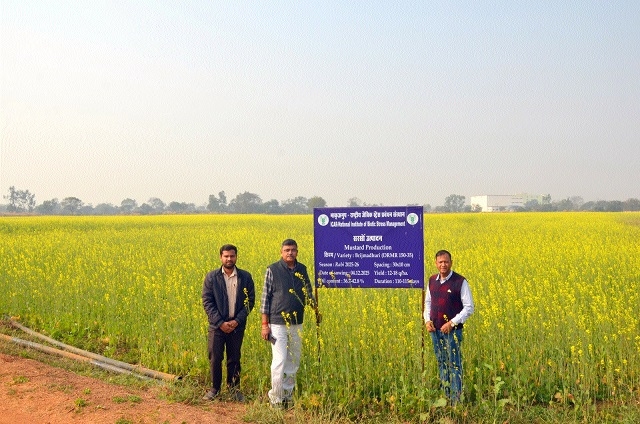
These varieties are suitable for late sown condition with 11-16 q/ha production and 39-41 per cent oil content. ICAR–National Institute of Biotic Stress Management, Raipur has actively taken up the promotion of rapeseed-mustard cultivation in Chhattisgarh through scientific research and institutional interventions particularly putting demonstrations under SCSP and TSP schemes. Field evaluations conducted during last three years revealed encouraging results for the variety DRMR-150-35, which exhibited early maturity like 95–110 days, making it highly suitable for sowing during mid-November to first week of December after rice harvest.
Notably, no incidence of key pests and diseases was observed except aphids, indicating its strong adaptability for biotic stress tolerance. Director of ICAR-NIBSM and Former Director ICAR-Indian Institute of Rapeseed-Mustard Research Dr P K Rai and Joint Director Dr Pankaj Sharma, who were actively involved in successful implementation of World Bank funded Assam Agribusiness and Rural Transformation Project (APART) for rapeseed-mustard area expansion in Assam as Chief Consultant and Key Expert emphasized that rapeseed-mustard cultivation in rice-fallow areas in Chhattisgarh can be scaled up through wider adoption of improved varieties, ensuring timely seed availability
there by un-cropped
area can be transformed into productive and profitable agricultural landscapes.