‘Digital Setu’ by PM Modi connected India with Bharat: Shehzad Poonawala
| Date :23-Feb-2026 |
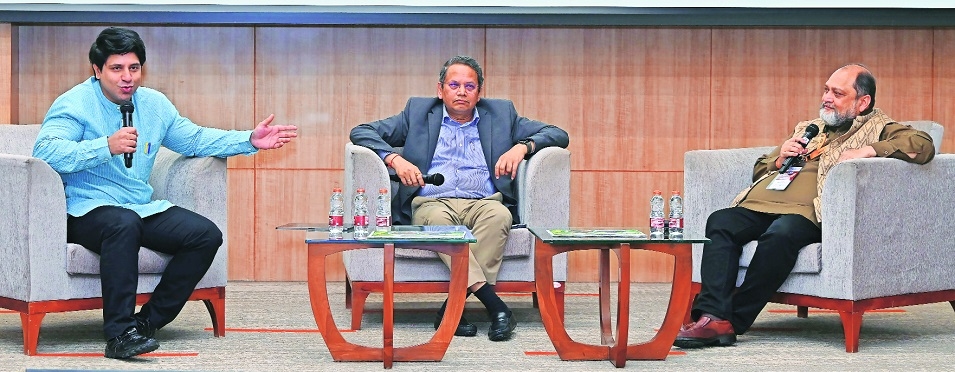
Shehzad Poonawala, Dr Vijay Chauthaiwale, and Ashish Kulkarni during a panel discussion at CIMCON’26 on Sunday. (Pic by Anil Futane)
Staff Reporter :
“Just like Shri Ram built Ram Setu to connect Bharat and Lanka to bring back Ma Sita, PM Modi built digital setu that connected Bharat with India and reduced the gap between rich and the poor,” said Shehzad Poonawala, Spokesperson, Bharatiya Janta Party on Sunday. He was speaking at the CIMCON’2026, central India’s largest management conclave, in a discussion on ‘Tech, Trust, and Transformation: India’s 10X Growth Story,’ with Dr Vijay Chauthaiwale, In-Charge, Department of Foreign Affairs, Bharatiya Janata Party. The session was moderated by renowned businessman Ashish Kulkarni.
Shehzad Poonawala, spokesperson of the Bharatiya Janata Party, emphasised the wide-ranging reforms undertaken by the Government over the past decade, stating that they had driven growth across sectors and strengthened public trust.
“Over the last decade, India has moved ahead confidently with three AIs — Aspirational India, Ambitious India, and Atmanirbhar India. Citizens can feel the shift in governance from serving ‘Mewa’ to delivering meaningful ‘Sewa’ to the people,” he said.
Poonawala argued that technology, much like democracy, was once limited to the elites but has now become people-centric. He credited digital
initiatives for bridging socio-economic divides and improving service delivery, adding that the government’s focus
on transparency and inclusion had expanded opportunities for the marginalised sections of society.
Dr Vijay Chauthaiwale echoed similar sentiments, appreciating what he described as the Government’s decisive digital push. “The greatest success of the Government has been the democratisation of technology, which has transformed lives at scale,” he said. Highlighting India’s growing global stature, he observed that the country now stands as a dominant force on the world stage.
“The technology developed by India is not mediocre; we have ensured that it is accessible, affordable and efficient,” he remarked.
Dr Chauthaiwale further noted that the growth of industries driven by new technologies had helped India build a bond of trust internationally. He cited India’s vaccine development and distribution efforts during the COVID-19 pandemic as a glowing example of innovation combined with responsibility. According to him, the country demonstrated both scientific capability and humanitarian commitment during a global crisis.
He also underlined the structural transformation of India’s economy from a consumption-driven market to a production and innovation hub. “Earlier, India was seen largely as a consumer market where companies came to sell their products. Today, India is also a manufacturer and innovator,” he said. He added that several countries are now partnering with India, driven by what he termed ‘FOMO’ — fear of missing out — on India’s growth trajectory.
Taking the discussion further, Poonawala outlined a long-term vision for the next 10 to 15 years. “If we follow RAM and GITA, then India will become Mahabharat,” he said, explaining the acronyms as pillars of national development — R for Rashtrasuraksha, A for Arthavyavastha, M for Mahila Suraksha; G for Good Governance; I for Infrastructure; T for Technology; and A for Atmanirbharata. He said these elements would serve as foundational principles in realising the vision of a Viksit Bharat by 2047.