Pride of Gondia at risk: Declining wetlands threaten sarus cranes
03 Feb 2026 11:39:14
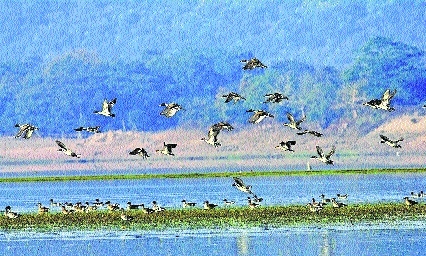
Migragtoy birds at a water body in Gondia district. (File pic)
Window on Vidarbha
By Apoorva Methi :
World Wetlands Day is observed globally on February 2 to commemorate the signing of the Ramsar Convention on Wetlands on February 2, 1971, in Ramsar, Iran. Celebrated since 1997, the day highlights the critical role wetlands play in sustaining biodiversity, regulating climate, and supporting human livelihoods.
Despite their importance, nearly 90 percent of the world’s wetlands have been lost or degraded since the 1700s. Alarmingly, wetlands are now disappearing three times faster than forests.
These ecosystems are vital for biodiversity conservation, climate change mitigation and adaptation, freshwater availability, and the global economy.
Emphasising the urgent need for conservation, noted nature conservationist and President of Sustaining Environment And Wildlife Assemblage (SEWA) NGO, Sawan Bahekar, said enhancing awareness at both national and global levels is essential to halt the rapid degradation of wetlands and promote their restoration.
The theme for World Wetlands Day 2026 is “Wetlands and traditional knowledge: Celebrating cultural heritage.” The theme highlights the deep connection between wetlands and indigenous traditions, cultural practices, and knowledge systems. It stresses the integration of traditional wisdom with modern science for effective conservation while recognising wetlands as cultural assets that provide essential services such as water purification and flood control.
Wetlands serve as pillars of biodiversity, acting as crucial habitats for migratory and resident birds, fish, amphibians, and diverse aquatic plant species. Their ecological functions include groundwater recharge, flood control, and buffering ecosystems against climate change impacts. In rural areas, wetlands also support livelihoods through fisheries, agriculture, and tourism.
In Gondia district, the Lohara and Paraswada wetlands were earlier rejuvenated through joint efforts by SEWA NGO, the Social Forestry Department, Local Biodiversity Committees, and the Maharashtra State Biodiversity Board. This initiative resulted in a significant improvement in biodiversity, with the lakes once hosting lakhs of migratory and local birds.
However, due to the absence of consistent and effective management, these wetlands have gradually degraded again. Today, bird-watching towers stand merely as structures, while essential ecological components such as aquatic vegetation, food chains, and natural habitat features have largely vanished.
The Sarus Crane, the world’s tallest living flying bird and a symbol of pride for Gondia district, depends heavily on healthy wetland ecosystems for food, breeding, and shelter. Bahekar noted that the Sarus Crane population in Maharashtra has declined drastically and is now reduced to only a handful of individuals.
This decline, he said, is a clear indicator of widespread wetland degradation rather than the crisis of a single species.
“For the long-term conservation of the Sarus Crane, it is vital to focus not only on species protection but also on the restoration and sustainable management of wetlands,” Bahekar stated. Measures such as preventing encroachment, improving water quality, and increasing community participation are crucial to ensuring the survival of both the Sarus Crane and overall biodiversity.
Highlighting the role of public awareness, Kanhaiya Udapure, member of SEWA NGO, Gondia, said World Wetlands Day serves as an effective platform to build understanding and sensitivity toward these ecosystems. “It inspires concrete, action-oriented, and long-term conservation efforts,” he said.
Udapure further warned that increasing urbanisation, unregulated development, excessive exploitation in the name of the Green Revolution, and encroachment have placed wetlands under severe threat. If timely and sustainable measures are not taken, wetland degradation could lead to water scarcity, biodiversity loss, and long-term impacts on livelihoods dependent on lakes and reservoirs.
Emphasising collective responsibility, Bahekar stated that wetland conservation requires coordinated efforts from government agencies, administrators, and citizens alike. “Only if wetlands survive will the environment survive, and only if the environment is protected will the future of human life remain secure,” he said.