Gandhi Nagar-Shraddhanandpeth Square road crying for urgent attention
| Date :09-Feb-2026 |
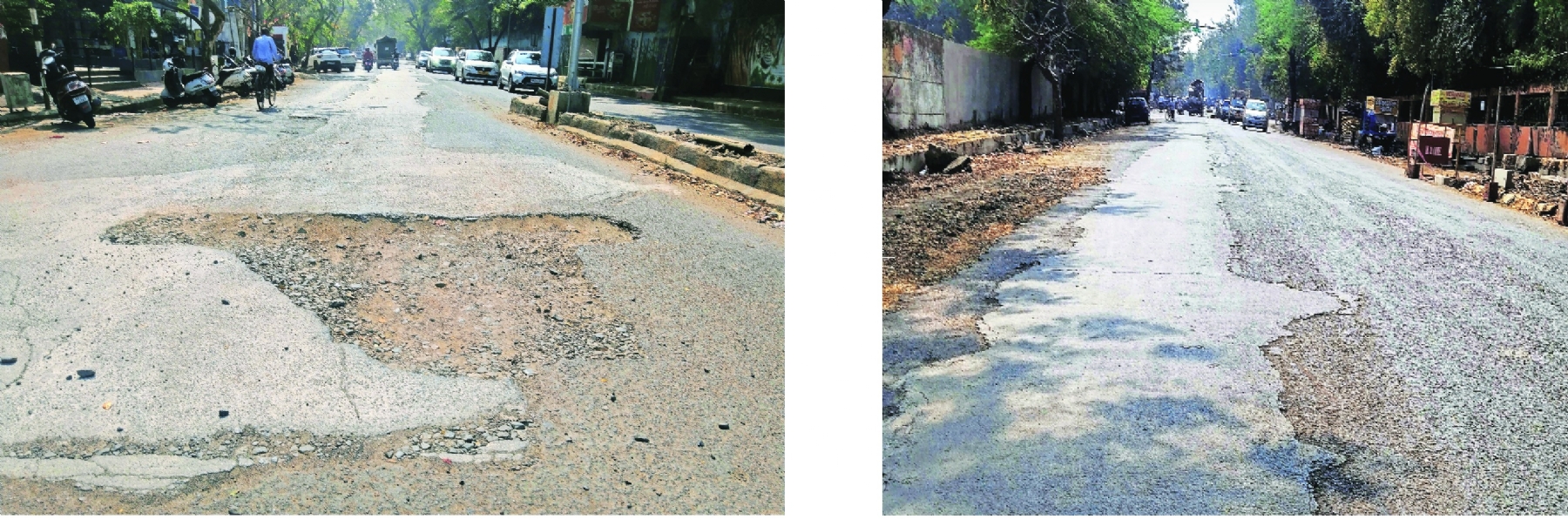
Large pothole filled with gravel and stones, posing a serious risk in case of a fall. (R) Partially cemented stretch of road between LAD Square and Abhyankar Nagar Square. (Pics by Anil Futane)
By Reema Mewar :
One of Nagpur’s busiest commercial hubs, Gandhi Nagar-Abhyankar Nagar area, continues to grapple with severely deteriorated road infrastructure that has troubled commuters for years. The stretch from LAD Square through Abhyankar Nagar Square and VNIT Square up to Shraddhanandpeth Square presents a hazardous driving experience, raising concerns about commuter safety and civic accountability. Despite its strategic importance in housing emerging urban markets, witnessing constant traffic movement, and accommodating the Visvesvaraya National Institute of Technology (VNIT), the condition of these roads remains far from satisfactory.
Adding to residents’ frustration is the Nagpur Municipal Corporation’s (NMC) reported redevelopment plan announced in late November 2025. The proposal included widening footpaths, creating a dedicated cycling track, improving parking facilities, and upgrading overall infrastructure. However, months later, no visible progress has been made, leaving daily commuters to navigate the same unsafe conditions. The area was relatively well developed, until the implementation of the Amrut 2.0 scheme wherein roads were dug up to lay new pipelines, intended to boost the city’s water supply system. However, the roads constructed after laying the pipes were of very poor quality, something that continues to trouble locals to this day.
Half-cemented roads pose safety risks: A major concern along this stretch is the patchwork approach to repairs. Originally tarred roads have been partially covered with layers of cement, seemingly as a quick fix for potholes rather than a structured resurfacing effort. “Instead of improving drivability, the uneven blend of tar and cement has created a dangerously irregular surface,” said Anu Deshmukh, an IT sector employee. “For two-wheeler riders in particular, the road has become treacherous.
The hardened cement patches are not level with the surrounding surface, making the stretch bumpy and unstable,” she added.
Crater-like potholes: Compounding the issue is the presence of large, crater-like potholes scattered across the route. “These potholes are visible exactly where the cement road is starting. If they have cemented one road, then why not cover the whole stretch properly? Then at least potholes could be avoided. We are often forced to slow down abruptly or swerve to avoid these cavities. During peak hours, this could prove dangerous, particularly when everyone is attempting to manoeuvre away from these potholes.” Ketan Goeher, a local resident commented.
No streetlights: The absence of functional streetlights has further amplified safety concerns.
After dark, long stretches of the road are left in near-total darkness, forcing commuters to rely solely on their vehicle headlights to navigate the damaged surface.
Kishor Khemlapure, a business owner nearby, said, “Poor visibility makes it difficult to spot potholes, uneven cement patches, or unexpected obstacles in time to react. For many residents and late-working professionals travelling through here, the commute has become nightmarish.”
Until the promised redevelopment materialises, residents and daily commuters remain burdened by infrastructure that falls short of the area’s economic and educational significance. For a locality that serves as a key artery of the city, the prolonged neglect raises pressing questions about when lasting solutions will finally replace temporary fixes.