NHRC probes liquor shop next to Arera Colony Temple
Date :09-Feb-2026
Staff Reporter :
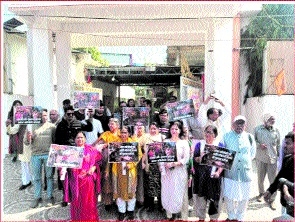
The issue of liquor shops operating near religious and residential areas once again came under sharp focus in Bhopal after National Human Rights Commission (NHRC) member Priyank Kanoongo conducted an inspection of a wine shop located near Arya Samaj temple in Arera Colony’s 10 No. (in the most buzzing part of the city) Market on Sunday.
The inspection exposed serious violations of excise norms and triggered strong reactions from local residents, elected representatives and social activists.
During the visit, Kanoongo interacted with devotees at the temple and local residents, who complained about the liquor shop’s proximity and its impact on public safety and religious dignity. He took strong exception to a written reply submitted by the district administration and the excise department, which claimed that the Arya Samaj temple was not registered. Reacting sharply, Kanoongo said, “Today, I came here myself to see who these people are who are demanding proof of God’s existence. Faith and religious places cannot be insulted under any circumstances.”
To verify the situation on the ground, NHRC member personally measured the distance between the temple and the liquor shop using a measuring tape. As per the statement by complainant Tripathi, the measurement revealed that the shop was located less than 50 metres from the temple, clearly violating excise rules.
Taking serious note of the lapse, Kanoongo reprimanded excise officials and directed that the liquor shop be shut down immediately for operating in violation of set norms.
Local resident Vivek Tripathi, who has constantly been raising the issue since long time, informed the NHRC member that the liquor shop was being run illegally on a residential-use plot within a housing area.
He further stated that following repeated complaints from residents, the Bhopal Municipal Corporation had issued a notice on November 19, 2025, directing the operator to stop all commercial activity within 10 days.
Despite this, the shop continued to function openly. Residents also alleged that an illegal drinking spot (ahata) was being operated under a tarpaulin, encouraging public drinking—an offence under the law.
Residents expressed concern over what they described as administrative indifference and possible collusion. Addressing these concerns, Kanoongo said
that protecting the dignity of religious places, ensuring citizens’ safety and enforcing the law were the administration’s responsibility.
He added that action would also be taken against officials found guilty of negligence. The issue has also highlighted similar unresolved problems in other parts of the city. Councillor from Kotra Nehru Nagar Monu Saxena pointed to a long-pending dispute at Nehru Nagar Square, where a liquor shop continues to operate in a busy public area despite protests. He said presence of the shop and an illegal drinking spot (ahata) has made the locality unsafe, especially for women, girls and daily commuters. Saxena said he fought a legal battle for nine years but eventually withdrew after seeing no resolution, adding that while protests forced the shop to remain closed for three days, it could not be shifted permanently. The shop was earlier running in BMC’s building and later shifted to a private building. Monu Saxena said liquor shops seriously endanger public safety and damage the local economy. He pointed out that families and regular customers stop visiting such areas, leaving only vendors who sell snacks, water and disposable glasses to alcohol consumers to survive.
He demanded a fundamental overhaul of the excise policy, alleging that authorities often use registration status of temples and schools as an excuse to allow liquor shops to function in sensitive locations. He argued that liquor outlets should be shifted to designated commercial zones or malls, not residential streets. Also administrative and police control should be strengthened to maintain peace in such areas. Echoing similar concerns, Councillor of ward number 10, Shivaji Nagar, Guddu Chauhan said that as per norms, alcohol sales should not be permitted near any religious institution, whether a temple or a mosque. He demanded immediate relocation of such shops, warning that unchecked liquor outlets not only threaten public safety but also erode social harmony. Residents have now indicated that if prompt action is not taken, they may approach the court seeking accountability from both the contractor and the district administration, raising fresh questions about enforcement, governance and public interest in excise policy.