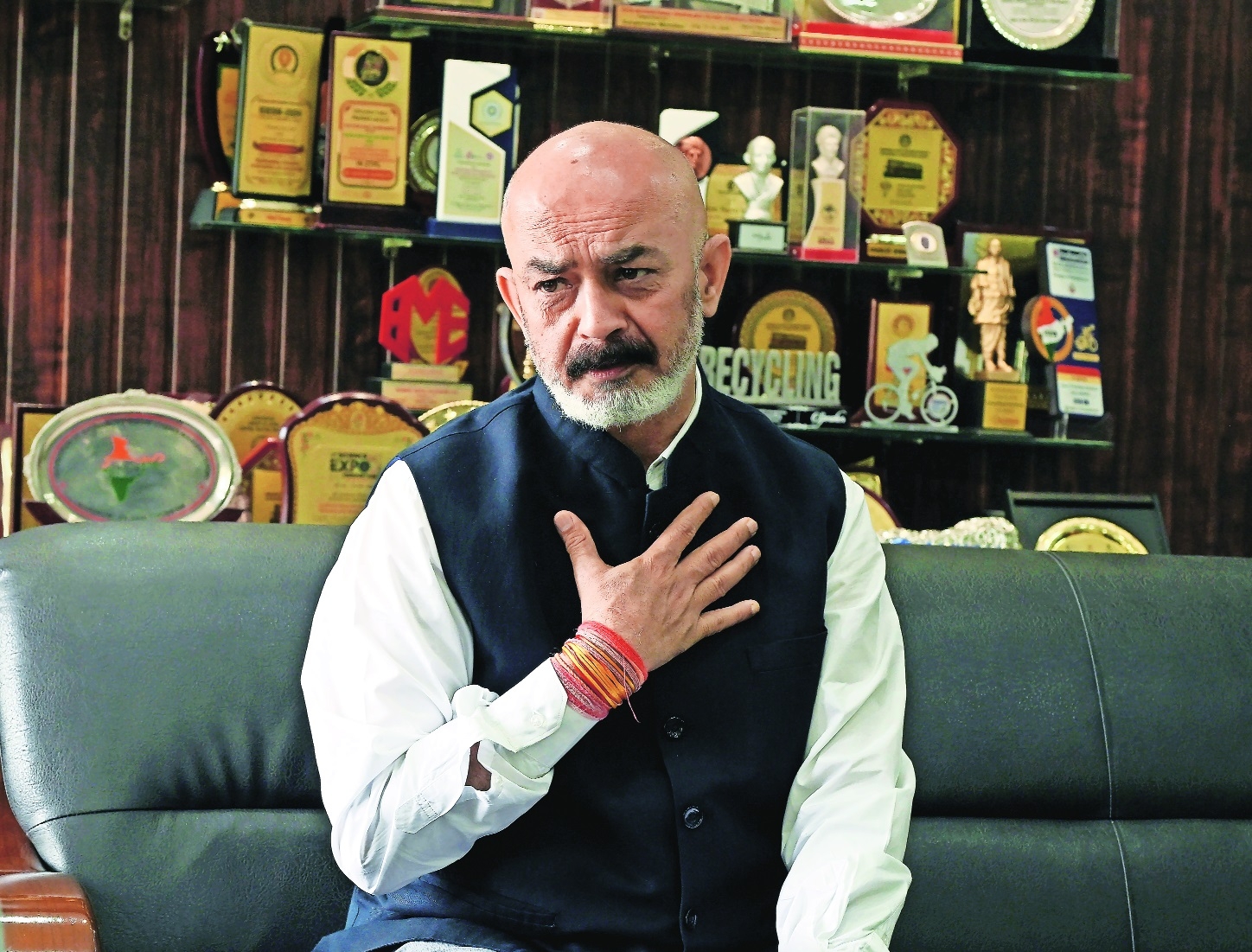
The aluminium man: Dr. Anupam Agnihotri
| Date :10-Mar-2026 |
By Vijay Phanshikar :
Spend just a few minutes with him, and you realise his deeply sensitive mind -- and sensible ways. In a few more minutes, you realise that you are in the company of a very important signatory of the country’s aluminium research, development and design movement -- and has a say in every scientific development in that regard, as a pivot, as an anchor. Over the past 35-plus years, the country’s scientific thinkers and planners have treated aluminium not just as ‘a’ metal but as a concept and wove a range of thought-and-action effort to make the best use of it in all its derivatives.
Dr. Anupam Agnihotri, as the Director of Jawaharlal Nehru Aluminium Research Development and Design Centre (JNARDDC), Nagpur, has been playing a critical role in this range of activities with aluminium technology related to energy audit, environmental monitoring, and modernisation. At the forefront of critical technology-utilisation, Dr. Agnihotri chooses his words carefully, but does not sound clammed up. He is open. He welcomes questions -- and responds to those without seeming to conceal anything. In other words, he knows, what, how, why and where to express.
Even as he presides over the intense scientific activity and administrative work at the sprawling facility, Dr. Anupam Agnihotri’s first concern is to create a “happy organisation”. Though he uses an everyday lingo saying that, the poetry in Dr. Agnihotri’s words cannot be missed.
A hint of a smile is all the time etched on his face as he talks about his work, his organisation, his colleagues -- scientific and administrative. Even though he is engaged in several national-level research and development projects in critical technologies, Dr. Agnihotri finds time to play cricket on the campus and to interact with colleagues.
What is the source of his friendly persona ? -- one may ask.
And the answer, in effect, is: ‘My parents. They ingrained into my thought the importance of being
nice to everyone and be as humble as possible’. Dr. Agnihotri’s parents were
symbols of time-tested, traditional value-system -- Honour your word. Respect
everybody. Take life seriously. Work hard -- they seemed to insist.
Those values have stayed with Dr. Anupam Agnihotri.
One of the values that
he got from his parents
was ‘hard work’. “It always pays. But it should necessarily be accompanied by
dedication and deep involvement. That is the actual mode, method and manner of leadership. That way, one establishes a role model
for the organisation,”
Dr. Agnihotri says matter-of-factly.
As he heads a hi-tech
scientific research and
development organisation, how does he handle the
actual operational
leadership challenge beyond philosophy ?
To this question, Dr. Agnihotri replies, in effect, ‘People come with many issues, many suggestions, many solutions to vexed questions -- whether
scientific or administrative or with obvious human
dimensions. As a leader,
my response is: Never say
‘no’ to anybody. That fosters creativity, in the sense
people feel enthused to
communicate more openly. An organisation that
fosters creativity has
every reason to be a happy organisation’, Dr. Agnihotri asserts.
For somebody pursuing studies in leadership, these responses embody a scientific thought on the subject.
Even though he is Director of JNARDDC for years, Dr. Agnihotri has another approach to leadership -- which needs to be kept in mind. He allows others to go up front and lead projects, take ownership -- which he describes as “leading from behind”.
As the conversation proceeds deeper, you realise that Dr. Anupam Agnihotri is rather a person in a rarified league of people. He is all the time looking for work -- not just engagement, but a serious involvement in mission-mode. “This has been my way. If others cribbed and cringed, I looked forward to more and deeper and higher work. Yes, I do believe in smart work, all right. But the word “smart” should not be used as a replacement of “hard” work. One should do both, hard and smart work -- as an essential virtue”, he stresses.
Dr. Agnihotri’s academic and scientific credentials are impeccable, to say the least. He has a B.Tech. degree from Indian Institute of Technology (IIT) Kanpur, in Metallurgy -(Fatigue Failure of Metals); M.Tech. from Visvesvaraya Institute of Technology (VNIT) Nagpur in Metallurgy, Doctorate (PhD) from VNIT in Metallurgy.
During his upward trajectory to become the Director of JNARDDC in 2014, Dr. Agnihotri held various positions such as Managing Director (Additional Charge) of Bharat Gold Mines Ltd; Director (Additional Charge) NIMH; HoD, Aluminium Electrolysis and Downstream; Technical Secretary to Director; Scientist (from Grade I to Grade IV); Visiting Scientist, United Nations Development Programme in Hungary.
The honours and awards, too, have flowed his way: Scientific Contribution Award of the International Bauxite Alumina and Aluminum Society; Scientific Institutional Excellence Award; Scientific Excellence Award; Metal Asia Award; Atma Nirbhar Award and Dr. Raja Ramanna Award of the Indian Society of Analytical Scientists; and the last year’s honour for JNARDDC as a Top-Five Research Institute.
However, Dr. Agnihotri mentions all these academic and scientific honours only in the passing -- as an outcome of lifetime of dedicated work. His sights are set on creating a happy organisation that delivers -- for national cause, and also works as an ecosystem of growth for individual members. Personally, Dr. Agnihotri is an integral member of national-level research projects such as the development of a Super Aluminium Conductor, Perform, Achieve, and Trade (PAT) Studies, and is associated with Defence Research and Development Organisation’s (DRDO) ambitious project on indigenisation of aluminium alloys.
The scientific research and development work conducted by the JNARDDC under Dr. Agnihotri’s leadership is massive in size and import. His hands are full -- with scientific work in the institute, with working together on several projects with other institutions nationally and internationally. He also needs to travel a lot to pursue his work with a missionary zeal.
Yet, behind all these is a man who also looks forward to spending quiet time at home (when situation permits) -- and allowing his team to take the lead.
In that manner, he follows his dictum -- of leading from behind.