Chandrayaan-5 to have heavier lander with longer mission life: ISRO Chief
| Date :12-Mar-2026 |
BENGALURU :
INDIA is planning to collect samples from the Moon and bring them back to Earth under Chandrayaan-4, while Chandrayaan-5 will involve a heavier lander with a longer mission life, ISRO Chairman V Narayanan said on Wednesday.
He also spoke about ISRO’s future missions including the one to study Venus and the other on Mars landing mission.
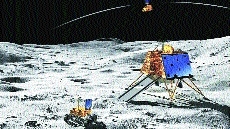
“Now we are working on the continuation of the Chandrayaan programme. In Chandrayaan-4, we plan to collect samples and bring them back. Chandrayaan-5 will involve a heavier lander with a longer mission life,” he said at the inaugural ceremony of ISRO’s fourth edition of the Space Science and Technology Awareness Training (START 2026) programme here. He recalled that in Chandrayaan-3, the lander’s mission life was only 14 days.
“In the future mission, we are talking about a life of around 100 days. The rover will also be heavier. Chandrayaan-3 had a rover of about 25 kg, while the future mission will have a rover of about 350 kg,” Narayanan said.
Referring to ISRO’s future programmes like the Venus Orbiter Mission, he said, “We have already accomplished the Mars Orbiter Mission, and now we are working on a Mars landing mission.”
“These are some of the projects being discussed for Government approval.
So there is a lot of interest in the science area.” He noted that under Prime Minister Narendra Modi, the vision of the space programme has been expanded and said, “We are currently working on the Gaganyaan programme and are planning to send our own astronauts into space and bring them back safely, possibly within the next two years.”
“We are also planning to build our own space station by 2035. Additionally, we are working on landing Indians on the Moon and bringing them back safely by 2040. Brainstorming activities have already begun. So there are many activities happening in the space sector. Apart from application-related activities that ensure food security, water security, communication, and safety for citizens, there are many initiatives planned in the science area as well,” he added.
Narayanan noted that India’s space programme has accomplished 10 scientific missions so far, including AstroSat, which recently completed a decade in orbit and was still functioning very well.
He also highlighted India’s various lunar exploration missions Chandrayaan-1, Chandrayaan-2, and Chandrayaan-3 -- saying they led to many scientific discoveries. “We are progressing in a big way,” he added.
Highlighting the successful Chandrayaan-3 mission in the year 2023, the ISRO chairman said that India became the first country to successfully achieve a soft landing near the south pole of the Moon.
“Not only did we achieve the landing, but many discoveries were made. Around eight minerals were identified, seismic activity was studied, and the thermal profile of the Moon’s surface was understood. Electron clouds were also studied. So many discoveries have come from that mission,” he added.