For eateries, it’s time for innovation as LPG shortage bites
| Date :13-Mar-2026 |
Staff Reporter :
Panic among citizens has resulted in upsurge in demand of electrical alternatives
The escalating geopolitical tensions between the United States-Israel and Iran have sent shockwaves through the global energy market, the tremors of which are now being felt acutely on the streets of the city. As maritime supply routes face uncertainty and international fuel prices skyrocket, a critical shortage of Liquefied Petroleum Gas (LPG) has paralysed local commerce. What began as a distant conflict has rapidly transformed into a domestic struggle for survival, leaving gas agencies unable to meet the surging demand and forcing a total disruption of the city’s culinary landscape.
Kitchens without LPG: A struggle
for restaurants
For the hospitality sector, the gas drought is more than an inconvenience; it is an existential threat. Large-scale restaurants and small street-side cart owners alike are finding it impossible to secure the fuel necessary to keep their burners lit. The crisis has reached a point where distribution agencies have reportedly disabled their booking helplines to avoid the deluge of unfulfillable orders. In this vacuum, a black market has begun to emerge. Mayur Kowe, owner of Chaivaria cafe, reported that upon attempting to book a commercial cylinder on March 11, he was quoted a staggering Rs 3,400 by a private company’s agency, a price nearly double the standard rate.
For the small cart owners whose families rely entirely on daily cash flow from food sales, the situation is even more dire. With commercial cylinders unavailable or unaffordable, many have been forced to revert to traditional wood-fired chullahs. While this allows them to keep their eateries alive, it significantly slows down production and introduces health hazards, yet it remains their only alternative to a total loss of livelihood.
Rural areas turning to coal, traditional wood-fired chullahs
Residents of several slum settlements have begun stocking up on coal and firewood as an alternative cooking arrangement. The move is largely precautionary, with families seeking readily available options for daily cooking needs. Local residents say the trend has been driven in part by uncertainty and the absence of clear information from authorities regarding the situation around domestic cooking fuel such as LPG cylinders. As a result, many households in lower-income areas are turning to traditional fuels like coal and wood to ensure they have a back-up for cooking.
Clubs, similar establishments grind to a halt
The uncertainty of supply has forced even prestigious institutions to scale back operations. The VCA Club (VCARC) recently issued a notice to its members stating that LPG supply to large establishments is now entirely uncertain. Consequently, the club has taken the drastic step of closing its dine-in facilities effective from March 13. This move serves as a stark indicator that even high-resource organisations are unable to bypass the current logistical nightmare.
Domino effect on
gig workers,
delivery earnings
The shortage has triggered a secondary crisis within the gig economy. As cloud kitchens and traditional restaurants stop accepting orders due to lack of gas cylinder, the delivery ecosystem is collapsing.
On-line food aggregators have seen a massive dip in order volume, directly impacting the ‘last-mile’ delivery partners. Gig workers, who typically rely on a high volume of deliveries to make a living, are seeing their daily income slashed by nearly 50 per cent.
Daily earnings that previously averaged Rs 1,900 have plummeted to a mere Rs 900 to Rs 1,000. One delivery executive shared that while he used to fulfill 25 to 30 orders daily, the lack of available food at partner restaurants has reduced his capacity to hardly 10 orders per day.
For these workers, who bear the costs of fuel for their own vehicles and vehicle maintenance, this reduction in volume makes the job nearly unsustainable, threatening the digital infrastructure that Nagpur has come to rely on.
Tiffin services affected
The situation has also begun affecting tiffin service providers, many of whom rely heavily on LPG cylinders for daily cooking operations. Owners say the uncertainty around cooking fuel has disrupted their ability to prepare and deliver meals consistently. As a result, several services are temporarily pausing operations.
The disruption has particularly affected students and working professionals living away from their hometowns who depend on these tiffin services for their daily meals, leaving many to look for alternative food arrangements at short notice.
Demand shifts to electric appliances
On March 12, the Nagpur Residential Hotels Association (NRHA), led by President Tejinder Singh Renu, issued an urgent notice to its members addressing the ‘current shortage and irregular supply’ of commercial LPG cylinders. To manage this crisis, the association has strongly advised hotels to shift cooking operations to electricity via induction cooktops and electric fryers. Additionally, members are requested to limit or remove menu items that require high flames or prolonged cooking times. These drastic measures aim to conserve limited fuel stocks and ensure the hospitality sector can sustain basic operations until the supply chain stabilises.
Speaking on the current scenario with The Hitavada, Renu stated, “For those who can’t use wood-fired chullahs in their premises, I suggest them to quickly shift towards electrical appliances. One drawback of the induction is that very limited food can cook at a time but its more efficient than just waiting for the cylinder agencies to deliver the fuel. The time has turned hard now and we hope that soon this war ends and everything turns normal as before.”
Communication gap with gas agencies fueling panic
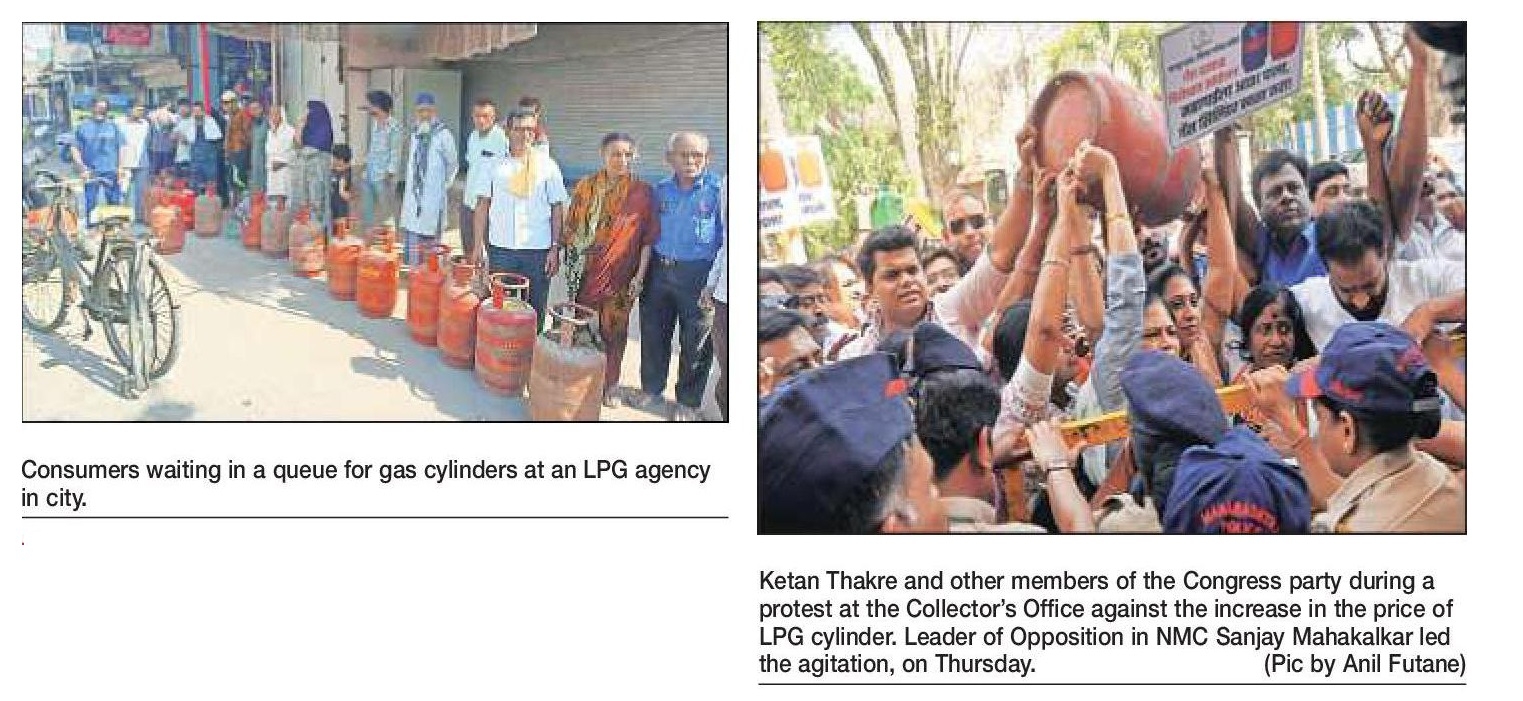
While many consumers report that domestic gas cylinders are still being delivered within one to two days after booking, a lack of communication from local distributors has caused growing anxiety among residents. Customers attempting to contact agencies have not been able to reach them as the numbers are either ‘unavailable’ or switched off. Lack of direct information has created uncertainty among consumers about the actual availability of cylinders.
Residents say that this communication gap has intensified fears of a shortage, prompting some people to attempt to stock up as a precaution. The absence of clear updates from distributors has therefore contributed to panic and speculation, even though deliveries in many cases are still taking place within the usual time frame.
Sharp spike in induction, electric cookware purchase
Uncertainty surrounding the supply of domestic cooking fuel has led many households in Nagpur to begin shifting toward electric cooking appliances.
Several large-scale and local appliance retailers in the city reported an unusual spike in sales over the past two days. Store owners stated that normally, they would sell about 15 units of induction stoves a month at most, but now that number has risen to between 30 and 40 induction cooktops a day.
“Some people show up here asking for electric gas burners
or self-heating cookers, and other absurd appliances that I
have never even heard of,”
said a local appliance store
owner. “Then when I ask them what brand offers such a product, they show some video
that they found on the internet. These videos are almost always fake, and it is my appeal to citizens to only invest in reputed brands when it comes to electrical appliances.”
Offices consider WFH as precaution
Some private offices in Nagpur are also considering temporarily shifting employees to a
work-from-home (WFH) arrangement as a precautionary measure until the current situation stabilises. According to sources in a few smaller firms, discussions are underway about allowing employees to work remotely for a short period to avoid disruptions and ensure smoother operations during
this time. The decision is however going to be taken only if there is real shortage of fuel, which at present is not the
condition.