Window on vidarbha PredatorPartners Melghat records extraordinary story of co-existence
| Date :05-Mar-2026 |
Amravati Bureau :
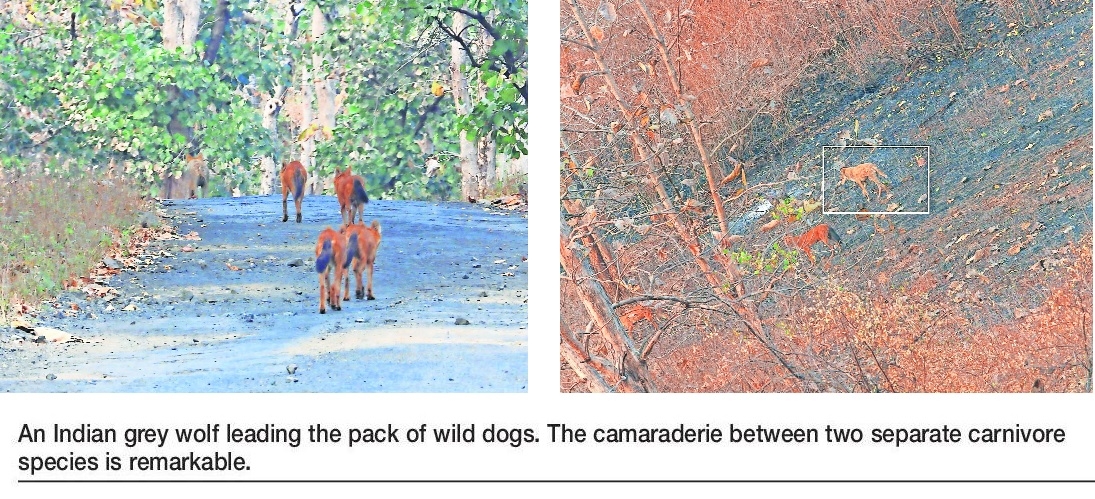
IN AN extraordinary and rare wildlife development, researchers at the Melghat Tiger Reserve have documented a remarkable instance of peaceful coexistence between two traditionally separate carnivore species - the Indian grey wolf and the Asiatic wild dog (dhole).
The rare sighting was made in the buffer zone of the reserve by Dr Sawan Deshmukh, senior wildlife researcher and Honorary Wildlife Warden of Amravati district. He observed an adult Indian grey wolf moving in close association with a pack of four wild dogs. Most strikingly, the wolf appeared to be leading the group - an unusual behavioural pattern that has surprised wildlife experts.
According to wildlfe experts both species are among the largest social canids in the Indian subcontinent, yet they typically occupy distinct habitats. Indian grey wolves are commonly found in open grasslands, semi-arid plains, and agro-pastoral landscapes, while ‘dholes’ primarily inhabit dense deciduous and evergreen forests. Encounters between the two species are rare, and cooperative or friendly interactions rarer.
Dr Sawan Deshmukh notes that this is only the third recorded instance of such inter-species association in India, and the first ever documented in Melghat. The observation further highlights the ecological significance and conservation value of the tiger reserve.
Notably, during the 40-minute observation period, no signs of aggression, growling, or territorial hostility were witnessed. Instead, the animals moved calmly and cohesively as a single unit. Dr Deshmukh emphasised that the adult wolf consistently stayed at the front, clearly guiding the group’s movement.
The incident is being considered highly significant for wildlife conservation and the study of interspecies social behavior.
Dr Deshmukh is currently
consulting with subject experts to further analyze the rare documentation and is preparing a scientific paper on the findings, which is expected to be published in an upcoming wildlife research journal.
This unprecedented sighting opens new avenues for understanding adaptive behavior and ecological dynamics among India’s top social predators.