AMTES: Building on belief
| Date :07-Mar-2026 |
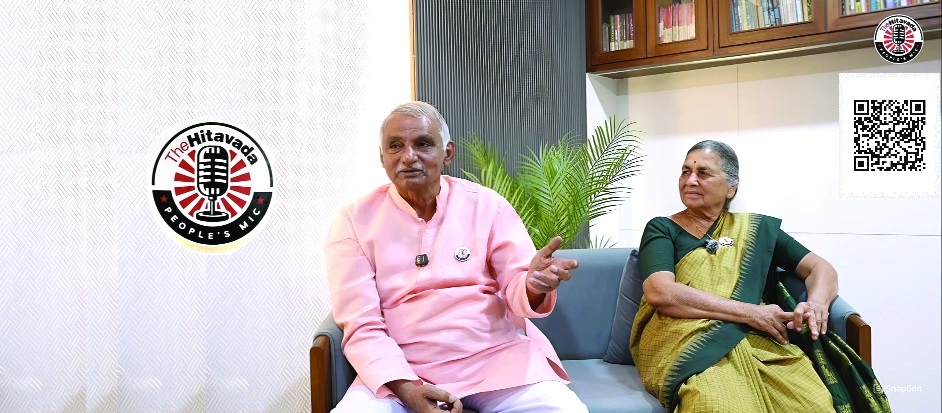
Humanitarians Padma Shri and Ramon Magsaysay Awardee Dr Prakash Amte and his equally decorated wife, Dr Mandakini Amte, reflect on their journey on The Hitavada’s The People’s Mic podcast. Scan the QR code to watch the full interview.
By Aasawari Shenolikar :
Two roads diverged in a wood, and I-
I took the one less travelled by,
And that has made
all the difference....
We started work in the jungles without expectations. I had grown up in Anandwan, where we were bereft of any luxuries, but we had enough to survive. What I noticed that day was that this (Gadchiroli) was a world very, very different from what I had read about in textbooks. This was the reality, and it shook me to the core.”
For Dr Prakash Amte, these lines are not merely poetry; they mirror the course of his extraordinary life.
While waiting for his MBBS results to be declared, he travelled back home, where his father, one fine day, arranged for a picnic. The family travelled deep inside the dense jungle, and when they stopped, the youngster looked around. Something stirred in the youngster’s mind and all he could think was - “This is my future, where I would like to continue my father’s legacy,” he recalls, in a candid interaction on The Hitavada’s The People’s Mic. In a conversation with Kartik Lokhande, Mentor at Maharashtra Knowledge Centre, Padma Shri and Ramon Magsaysay Awardee Dr Prakash Amte and his similarly decorated wife Dr Mandakini Amte, reflect on a journey built on simplicity, conviction and an absence of expectations.
“We started work in the jungles without expectations,” says Dr Prakash. Perhaps that is precisely what shaped their path. There were no grand plans, no carefully drawn roadmaps. They simply responded to the needs around them, step by step, with quiet resolve. Over time, that journey earned global recognition - including the Ramon Magsaysay Award, the Padma Shri, and even a commemorative stamp issued in their honour by the government of Monaco - all acknowledging their humanitarian work in the deep forests of Gadchiroli, among the Madia Adivasi.
The day of the picnic is etched vividly in Dr Prakash’s mind.
“That day, for the first time I saw the Madia tribals in a different light,” he says. “They were extremely poor, unclothed, frightened even by the sound of a vehicle. I had grown up in Anandwan, where we were bereft of any luxuries, but we had enough to survive. What I noticed that day was that this was a world very, very different from what I had read about in textbooks. This was the reality, and it shook me to the core.”
Walking up to his father, the legendary Baba Amte, he told him he wished to spend his life serving the people who needed help the most - in that jungle.
“Overjoyed, my father told me that my path should ensure that these primitive tribes could live with dignity,” he recalls.
Only later did he understand the deeper intent behind that picnic. Baba had just turned 60. Prakash was only 22. But the decision had already taken root.
And that was how the seed for Lok Biradari Prakalp was sown in the year 1973.
The journey was anything but easy. It took nearly two years just to get the land allotted. Around the same time, Prakash had fallen in love with Mandakini Deshpande, a medico, pursuing an MD in Anaesthesia. Stiff resistant from her family did not dampen Mandakini’s resolve and she chose to join him - not just in marriage, but in a mission. A surgeon and an anaesthetist, the couple began their work from a small hut that barely had the essentials.
“We didn’t have electricity for 22 years,” says Dr Mandakini, smiling, recalling times that were often difficult, sometimes even frightening, but not once were the duo discouraged by the circumstances in which they were working.
Initially, the Madia tribe kept their distance.
Modern medicine was alien to them. Gaining trust took time.
Then came the turning point.
A man, written off by a local doctor, at the Amtes’ insistence, was brought to their clinic on a cot. A week later, he walked back - carrying that very cot himself.
“That changed everything,” they recall.
Word spread. People began arriving for treatment in increasing numbers. “We didn’t have a proper lab, no operation theatre, no blood bank, no transport - what we had was only our medical knowledge, instinct, courage and belief,” says Dr Mandakini. Today, the project serves nearly 50,000 patients every year.
As they delved deeper into the life of the tribals, the Amtes were shocked at the malnourishment and were aghast when they realised one day that the patients did not have two square meals to eat. “Take your medicine after you have eaten food,” was one of the instructions. The patient gawked, uttered, “What food?!! We do not have food to eat”.
“That was when we understood the real problem,” says Dr Prakash.
The tribals owned small patches of land but lacked knowledge of farming methods.
The team introduced better seeds, improved techniques and basic support. Soon, crops improved, nutrition followed, and for the first time many families experienced a degree of financial stability. Surplus produce was bought for the growing community around the project - creating both income and food security.
But another demon raised its head - the demon of ignorance and illiteracy.
Amtes now satisfied with working of the healthcare, thought of opening a school so that children from the area could benefit. And so project ‘Ashram Shala’ was conceptualised.
With the community growing, the need for education became increasingly clear.
“We wanted the children to understand the value of learning,” says Dr Mandakini.
Convincing families took time, but eventually the school flourished. One story still fills them with pride - that of Dr Kanna Madavi, a tribal who went on to become a prominent surgeon and returned to serve the same region.
“Hamara bachcha doctor ban gaya,” people would say with unmistakable pride.
Forty years down the line, the project now offers NEET coaching, and in 2025 alone, eleven students from their school entered various medical streams.
Another unexpected chapter brought another turn in their life.
A chance encounter with an orphaned baby monkey led to the creation of an animal rehabilitation centre - Amtes Animal Ark - Orphanage-cum-Rescue Center at Hemalkasa. Over time, an unusual
partnership evolved with the local tribes.
“They bring us orphaned animals from the forest, and in exchange we give them rice,” says Dr Prakash.
Today, hyenas, leopards, deer, monkeys, bears and snakes coexist in this unique sanctuary - another example of coexistence between humans and nature.
The applause and accolades have not gone to the Amtes head. Remaining remarkably grounded, they still follow the simple philosophy ingrained during the growing up years - do your work, expect nothing, and avoid comparisons.
The duo speak warmly about the younger generation and their willingness to take up meaningful causes.
“We are proud that our sons and their spouses believe in our work and have taken up our cause.”
If there is one message they want to leave behind, it is this - protect the environment and respect the delicate balance of the world we live in.
And perhaps, most importantly, never hesitate to take the road less travelled.
Follow the selfless journey of the Amte couple, who have now taken a step back from active work as their sons and daughters-in-law are happily taking forward the legacy laid down by Baba Amte and strengthened by Dr Prakash and Dr Mandakini on our YouTube channel @TheHitavada1911. n