Mission Gaganyaan A success story in the making
Date :09-Mar-2026
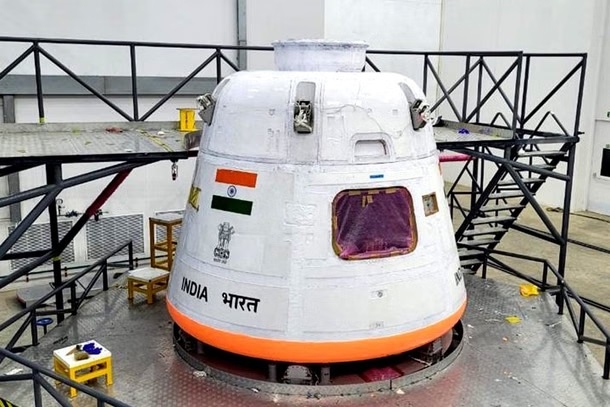
The space and the mysteries it holds have always fascinated mankind. And this fascination makes man strive again and again to ‘reach out for the stars’. India;s ambitious Mission Gaganyaan is one such space programme that rides on the hopes and prayers of Indians. Register the names of Ashoka Chakra awardee Shubhanshu Shukla, Prasanth Balakrishnan Nair, Ajit Krishnan and Angad Pratap. They are our ‘Vyommnauts’ (astronauts) who will be heading to space under Mission Gaganyaan.
For a layman, it is easy to say that Indians are going to space but little to many of us realise how much time and energy goes behind a space mission.
Mission Gaganyaan is a dream that was seen 20 years old and its realiastion is eagerly awaited. The story began in 2006. It was decided to develop a capsule with one-week endurance in space and capacity of just 2 astronauts. In 2007, the project was commissioned.The spacecraft vehicle was designed in 2008 for ISRO’s Human Spaceflight Programme.
It was sanctioned in 2009 but the mission was then hit by fund crunch. In 2014, the project was reconsidered and it was one of the main beneficiary in the Budget increase in 2014.
There have been many experiments which were carried out for the Mission since 20 years- CARE (2014): which tested crew module re-entry and safe ocean landing. Pad Abort Test (2018): Verified launch escape system for crew safety. Launch vehicle & engine tests (2019–2024): Human-rating of LVM3, CE-20 cryogenic engine, solid boosters, and propulsion systems. Parachute & recovery tests (2020–2025): Air-drop and sled tests to ensure safe descent and splashdown. Test Vehicle missions (TV-D1 and others): Validated integrated crew module, escape system, and recovery operations. Vyommitra robot missions: Tested life-support systems and crew operations before human flight. Astronaut training simulations (Gyanex): Crew confinement, emergency handling, and mission procedures. (Yuri Gagarin Cosmonaut training centre,Russia, ISRO Astronaut Training facility, Bengaluru) Microgravity & bio experiments: Studied human, plant, and biological responses.
Our scientists ad engineers have been working tirelessly since last 20 years on the mission. Even after many failures, they did not stop. The nation salutes them for it is their dedication that will facilitate India in sending humans into space.
By Devyani Belekar