Would Picasso have made Guernica today?
Date :09-Mar-2026
By Prantik Banerjee
 Picasso’s Guernica was displayed for public viewing even before the paint had dried. This was important for the exhibitors, the audiences, and the artist himself. The Nazi bombing had pounded the ancient town of Guernica in northern Spain in April, 1937 and had reduced it to a heap of rubble, smoke and dust. The acrid smell of gunpowder and the stench of rotting corpses hung in the air for weeks as the bombing wiped out the town, touching off international shock and outrage.
 Would Picasso have made Guernica today?
what was one of the first aerial bombings
of civilians, the fascist terror was unprecedented. Picasso who had been commissioned earlier by the Spanish Republican Government to do a painting for an international exhibition in Paris was shaken by the news. Guernica gave him both the subject and the reason to paint immediately – the horror of war and the suffering of people due to it. Using only black, white, and grey colours, Picasso created a masterpiece in two months, showing on canvas the violence and pity of war. So powerful was the impact of the painting – a collage of screaming mouths, dismembered bodies, brutalized animals, and a dead baby– that it shook the collective conscience of people world-wide. With its sheer scale, size and shapes, the picture shatters visual harmony and disturbs viewer perception. Guernica does what a thousand words would not suffice to distil the misery the war.
Picasso proved that art on atrocity is the sharpest medium of truth-telling. His painting lay bare the cruelty and chaos of war in black and white. If the bombings of Dresden, Guernica, Hiroshima, and Nagasaki have outraged artists to rush to the canvas to mirror the monstrosity of humanity, what would Picasso have done, had he lived in our catastrophic times? Would Picasso have picked up paint and brush to colour on canvas the killing fields of today’s wars? Wars that treat the death of thousands of civilians not simply as body count or collateral damage, but as prime targets? Also, if we did have our 21st century Guernica, would it have the same impact on audiences as Picasso’s did, nearly a hundred years ago? It is hard to say. For one thing, Guernica was a metaphor for the malaise of its time. In its collage of decapitated bodies, feet and mouths, the canvas splayed the cruelty and ugliness of war. Guernica did not, however, play out in an endless loop of media images.
The famous painting was exhibited in many countries over a considerable period of time. In its slow circulation and gradual unravelling, the painting made news that stayed news. There were no 24-hour news cycle or viral videos that caused the saturation of its impact. Guernica travelled to several cities in Europe and the Americas to singe public memory permanently. Ironically, even Francisco Franco, the fascistdictator of Spain, wanted Picasso to bring his masterpiece ‘home’. But Picasso refused.
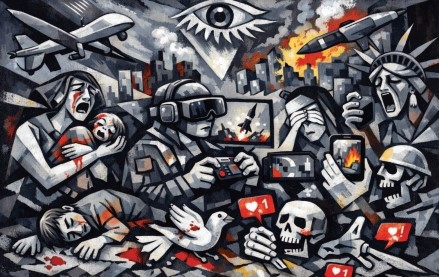
The power of his protest artwork lay in the bold, unorthodox strokes of cubism. The mural also stemmed from the unfortunate precedent that the bombing of civilians had set in war history. Today, tragically, images of bombed cities circulate daily. Catastrophe has become continuous rather than singular. The shock that made Guernica feel unprecedented is harder to isolate in a media-saturated world. Its unfortunate fallout has been that the social, moral, and psychological effects of war and trauma on us have been tokenized by ‘in-shorts’, tweets, and tik-tok bits.
Shock has been normalized and schmaltz has become spectacular. When we scroll image after image of attacks by ballistic missiles and drones, hitting not just military sites but schools, hospitals, and residential areas, we no longer feel the ‘monumentality’ of the event. We lose the ability to ‘place’ our experience of the horrific reality and memorialize it for time. Empathy is elbowed out to make way for the thrill of the next scroll or feed. Reels give to the most devastating events the ‘snuffiness’ of images – cropped, filtered, and memed. Even the most violent deaths are witnessed as bystanders recording ‘live’ the event; but seldom experienced for pain and sorrow. We trade ‘likes’ and ‘followers’ for shooting deeds that leave the living dead. We have become the living dead. At the height of the Gulf War, Jean Baudrillard, the French postmodernist thinker, wrote a highly controversial piece titled ‘The Gulf War Did Not Take Place’. In the essay, Baudrillard did not deny the ‘reality’ of the event, of a war happening in real time; nor did he show disrespect to the thousands of dead. His argued in the three-part essay that the daily media coverage of the conflict on television news channels had turned it into a ‘virtual’ war.
The war had become a ‘simulacrum’ – the real had become hyperreal – by the media’s generation of endless images to such an extent that its excessive representation presents a distorted ‘reality’ that is consumed by credulous audiences. Baudrillard showed how the collusion of technology, propaganda, and the seductive power of images have transformed the very perception of war. Media and digital technologies have diffused the violence of war into a spurious kind of mass entertainment. The battlefield is now a gaming zone played by invisible master controllers who direct the action from war rooms for the passive consumption of mass audiences. Advanced military technologies have also changed the nature of war. Zones of assault in most conflicts no longer require armies on the ground. Weapons of mass destruction are capable of unleashing fearsome havoc from faraway places by remote-control. Consequently, as drones, missiles and bombers do what they do by stealth, operated by power brokers and military heads sitting in war rooms, the media blitz annihilates our capacity for compassion and empathy.
The continuous screen time viewing of heat-sensing missiles and target-precision bombs bringing forth what appears as brilliant fireworks display deadens our response to such stimuli. Dazzled rather than petrified, viewers become purveyors of a pornography of grief. What was earlier the common man’s perception of war based on Hollywood movies, is now reel time on Instagram.
The causes and effects, however, of warmongering, have remained the same. What has made today’s war even more dismal, is the political brinkmanship of leaders who care more for a Nobel peace prize than genuine peace. Humanity ultimately ends up paying the price. It is also true that technology and media have dulled our perception and deadened our sensitivity. Our senses only crave for the sensational, and we live buried in our screens. Therefore, while spectacle has our eyes, it blinds us to what the real stakes are.
It is a sign of our desensitized times that Pablo Picasso, the maestro, who created Guernica, is today Picasso, the AI, that can generate a million Guernicas in a minute. Picasso froze a disruptive moment of history on canvas and turned it into a monumental allegory. Sadly, when the bombing of so many cities like Guernica has now become almost an everyday occurrence, even a great artist’s strokes may not awaken war hawks to the futility of war.