Public bears the brunt as BCLL operations shrink from 16 routes to 4
Date :18-May-2026
Staff Reporter :
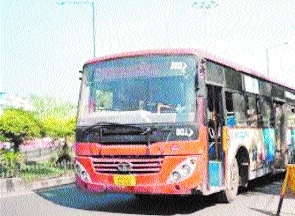
Bhopal’s public transport system, long considered the city’s lifeline, is currently facing its worst operational crisis. The low-floor bus services operated by Bhopal City Link Limited (BCLL) have ground to a near-total halt, leaving thousands of daily commuters stranded. This disruption comes at a highly critical juncture, as petrol prices in the capital have touched a record high of Rs 109.71 per liter and diesel has reached Rs 94.88 per liter. In the absence of affordable Government transport, citizens are being forced to rely on expensive private alternatives, severely straining household budgets of the working class.
Just two years ago, BCLL buses operated smoothly across 16 major routes in the capital.
Today, the service has shrunk to cover only partial operations on just 4 routes.
Regular passengers fear that any further rise in fuel prices will increase their monthly travel expenses by 10% to 12%. Left with no accessible public transit options, working professionals and students are spending a major portion of their earnings and pocket money on private transport.
Severe shortage of buses has hit students and working professionals the hardest. Srishti Parihar, a medical student, shared her plight, stating that she had to wait for nearly two hours at the bus stand to travel to AIIMS, after which auto-rickshaw drivers demanded an exorbitant fare of Rs 150
to Rs 180 for the distance. Similar scenes of distress are visible on Narmadapuram Road, a vital artery connecting Mandideep, Barkatullah University, and several key office clusters. In scorching sun with temperature soaring 42 degrees Celsius, commuters can be seen waiting for hours at dilapidated bus shelters. The situation is equally grim at Polytechnic Square, a crucial junction connecting MLB College, New Market, Hamidia Hospital, and the Old City.
Frequency of buses at this transit point has dropped to once every 70 to 80 minutes, compared to just 20 months ago when a bus was available every 10 minutes. Collapse of public transit system is also yielding serious social and environmental consequences.
Urban experts note that the decline in affordable bus services has triggered a massive surge in private two-wheelers and four-wheelers on the road. Consequently, this shift has not only intensified traffic congestion on major corridors but has also contributed to an estimated 15% spike in air pollution levels, posing a major threat to public health.
BCLL Chief Executive Officer Anju Arun stated that reduction in operational buses is primarily due to an ongoing legal dispute in court. She assured that the department is making continuous efforts to resolve the judicial matter swiftly and restore regular services.