C’garh performs best in child sex ratio
Date :29-May-2026
Staff Reporter
:
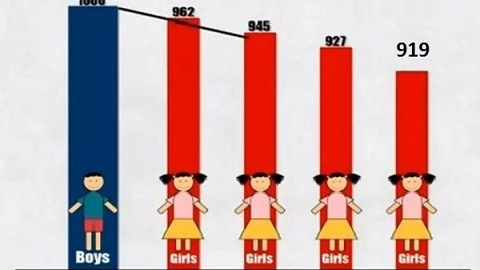
Chhattisgarh has emerged as the best-performing major State in the country in terms of sex ratio at birth, recording 978 girls per 1,000 boys, according to the latest 2025 Sample Registration System (SRS) figures. The state has even surpassed Kerala after more than two decades and has reported one of the best rural child sex ratios in India with 990 girls born per 1,000 boys in rural areas.
However, the data has raised serious concerns over the situation in urban Chhattisgarh, where the sex ratio at birth has sharply declined to 925 girls per 1,000 boys. The wide rural-urban gap of 65 girls indicates that illegal sex determination tests and female foeticide may still be prevalent in urban localities despite strict laws and repeated awareness campaigns.
The report shows that almost all major urban centres of the state have recorded poor figures. Raipur urban areas reported only 916 girls per 1,000 boys, while Bhilai-Durg recorded 919. Bilaspur urban areas showed one of the lowest figures at 903 girls per 1,000 boys, followed by Korba with 911. Rajnandgaon performed comparatively better with 934 girls per 1,000 boys, though still below the natural average.
According to the World Health Organisation (WHO), the natural sex ratio at birth is around 952 girls per 1,000 boys, equivalent to about 105 boys for every 100 girls.
Experts say a slightly higher number of male births is biologically normal as male babies are considered more vulnerable at birth.
However, a significantly lower number of girl births is often linked to social discrimination and sex-selective practices.
Health experts have expressed concern over the trend in urban areas. “It is worrying that all urban parts of the state have registered poor sex ratio at birth. This shows that even educated urban families still prefer male children and may be engaging in illegal practices,” said Dr Riya Parmanik, paediatrician and health activist.
Officials in the health department have also acknowledged the seriousness of the findings. Dr V R Bhagat, Executive Director and acting in-charge of child health in Chhattisgarh Health Services, said the report was ‘really worrisome’ and added that a detailed study of the data would be required before further comments.
Despite sustained efforts by the Health Department, Women and Child Development Department and district administrations, the issue of ‘missing girls’ continues to remain a challenge in urban Chhattisgarh. While the overall performance of the state is commendable, experts believe stronger monitoring and stricter enforcement against illegal sex determination and female foeticide are urgently needed in urban centres.