Legendary Urdu poet Bashir Badr passes away at 91; laid to rest at Bada Bagh Cemetery
| Date :29-May-2026 |
Staff Reporter :
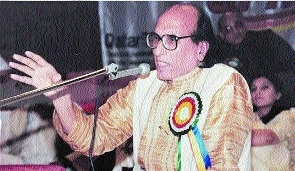
Legendary Urdu poet Bashir Badr passed away on Thursday afternoon at his residence, Bashir Manzil, in Bhopal. He was 91 and had been battling dementia for the past 14 years, a condition that had led to the loss of his long-term memory. Family sources confirmed that he breathed his last at approximately 12:15 pm. His mortal remains were laid to rest at the Bada Bagh Cemetery in Bhopal in the evening.
Born on February 15, 1935, in Ayodhya, Uttar Pradesh, Badr completed his early education in Kanpur and Etawah. He went on to earn his bachelor’s, master’s, and doctoral degrees from Aligarh Muslim University, where he subsequently served as a lecturer in Urdu. He later joined Meerut College, dedicating 17 years to the institution as the head of the Urdu department.
During the communal riots in Meerut in 1987, Badr lost his
home and an invaluable collection of books, including several unpublished literary works.
Following this devastating trauma, he relocated to Bhopal permanently with his wife, Rahat Badr. Reflecting on this profound loss in his poetry, he wrote, “Log toot jaate hain ek ghar banane mein, tum taras nahi khaate bastiyaan jalaane mein.” Literary contributions and timeless poetry: Badr is regarded as one of the most prominent figures in modern Urdu ghazal. He was honoured with the Sahitya Akademi Award for his ghazal collection, ‘Aas’. His other major literary works include ‘Ikaai’, ‘Image’, ‘Aahat’, ‘Aamad’, and ‘Kulliyat-e-Bashir Badr’. His book published in Devanagari script, ‘Ujaale Apni Yaadon Ke’, gained immense popularity across the country. Famous verses such as “Kuch toh majbooriyan rahi hongi, yun hi koi bewafa nahi hota” and “Dushmani jam kar karo lekin ye gunjaish rahe, jab kabhi hum dost ho jaayein toh sharminda na hon” remain deeply embedded in popular consciousness.