Early footprints of Indian Cinema lost to time
| Date :04-May-2026 |
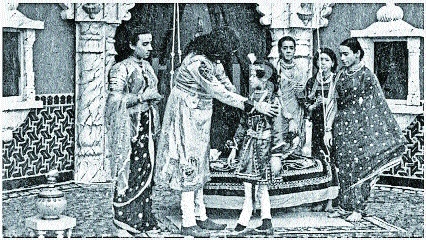
India’s first feature film
‘Raja Harishchandra’ had
premiered on May 3 in 1913.
Indian cinema began in 1913, but despite its rich 100-year legacy, India has lost nearly 9,000 to 13,000 films due to neglect, poor preservation and delayed digitisation. Films like Alam Ara and much of early regional cinema have disappeared. While some restoration efforts are underway, preserving films is essential to protect India’s identity for the coming generations.
Film production in India started around 1913 with the release of Dadasaheb Phalke’s film Raja Harishchandra. This makes it a heritage of roughly 112 years.
But the question is, how well have we preserved this heritage? Alam Ara, India’s first talkie was made in 1931 and is completely lost. No full print exists today.
This is not an isolated case. We have lost almost 9,000 to 13,000 films made between 1913 and 1964; the year when India officially started preserving films with the establishment of the National Film Archive of India in Pune.
A short timeline of major lost Indian films helps understand the scale: Alam Ara (1931), Kaliya Mardan (1919), one of the earliest silent films, mostly lost; and early regional films from Marathi, Assamese and Manipuri cinemas.
A film reflects the lives and world of a certain period. Losing a film is like losing a part of the past and history. And this loss happened largely because we simply were unaware of the technologies available for preservation. Then there was sheer neglect and bureaucracy.
Institutions like the National Film Archive of India (NFAI), set up to protect our cinematic heritage, have been underfunded and poorly managed. Without strong
government or public support, cinema
was not prioritised as something worth preserving.
Another key issue was physical decay. Early Indian films were recorded on nitrate reels, which are extremely fragile and highly flammable.
Many reels disintegrated or got damaged due to improper storage. Unfortunately, India lacked proper vaults or climate-controlled facilities to safeguard. these materials.
Raja Harishchandra (1913), India’s first full-length feature film and a landmark in Indian cinema, sadly exists today only in small fragments. The complete original print is lost, and what remains are just pieces preserved in archives or private collections. Moreover, silent-era heroines and experimental filmmakers, once celebrated for their contributions, have largely been forgotten because their films have vanished. Their ground-breaking work survives only through posters, memories, and written accounts.Today, we mostly depend on these secondary sources to understand and appreciate that era.
The actual films have been lost, creating a huge gap in India’s cinematic heritage that is difficult to recover.
Nothing can be done about what is lost. But some people are trying to save what remains.
Recently restored Indian films include partial restorations of Raja Harishchandra, Satyajit Ray’s early works restored with international help, and multiple restorations of Pather Panchali (1955).
Without the treasure of early cinema, future filmmakers and audiences will
not fully understand their roots or the journey of Indian cinema. There is still time to save what remains, but only if we start treating cinema as valuable heritage, not just entertainment.
By Shubhavi Ukhalkar