Highest water stock in reservoirs in Amravati and Nagpur divisions
| Date :05-May-2026 |
Staff Reporter :
State Government urges citizens to utilise water prudently as El Nino phenomena may lead to water shortage in dams in coming months
Despite the State Government’s concern about El Nino’s impact in coming southwest monsoon, Vidarbha’s Amravati and Nagpur divisions have the highest water stock in the State till date.
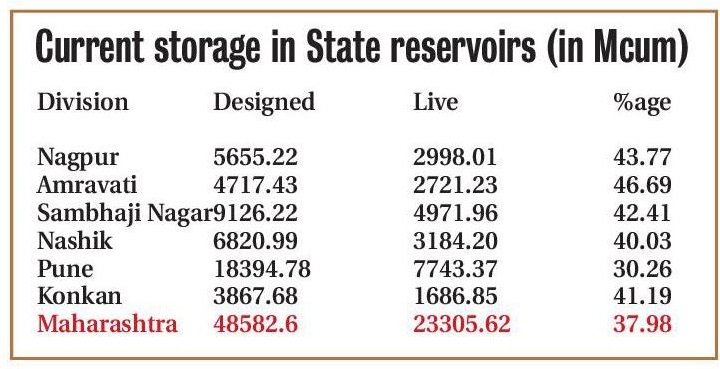
Reservoirs in Amravati division have highest 46.69 per cent water stock followed by Nagpur division with 43.77 per cent water stock as of Monday.
Maharashtra, currently, has 23,305.62 Million Cubic Metres (Mcum) of water stock in its reservoirs, which is 4.88 per cent higher than last year.
Despite improved storage, Chief Minister Devendra Fadnavis has cautioned against complacency in view of the
possible impact of El Nino on water stock in the State in monsoon. Fadnavis, recently, in a
meeting urged people of Maharashtra to use water carefully and conserve it to avoid any crisis situation.
El Nino is a climate phenomenon in which the surface waters of the central and eastern Pacific
Ocean become unusually warm. It affects the weather world-wide, including a weaker monsoon and risks of drought in India.
The Chief Minister directed officials to ensure strict planning of available water resources so that the drinking water supply is sustained till August 2026.
As per the data shared by Water Resource Department in its website, Pune division has the lowest water stock with just 30.26 per cent of water available. Whereas, last year, the water stock in dams of Pune was just 26.78 per cent. The 724 dams of Pune division has just 7743.37 Mcum of water. With 40.03 per cent, Nashik division has the second lowest water stock in dams. Last year it had 37.42 per cent of water. Konkan division has 41.19 per cent of water stock and Sambhaji Nagar has 42.41 per cent water reserved in 929 dams. Last year Sambhaji Nagar had just 32.65 per cent of water stock.
The previous El Nino impact was happened in 2014 and as per officials, due to El Nino, reservoir levels had dropped significantly in the past by 12 per cent in 2014 and around 14 per cent in 2015, leading to water scarcity in those years.
On October 15, 2014, the water stock in the state’s dams was 24,700 Mcum, while on the same date in 2015 it fell to 17,698 Mcum. Keeping the past data in mind, the state government is planning to overcome the crisis by proper planning.