Oppn, farmers’ organisations vociferous over crop procurement, MSP issue
| Date :07-May-2026 |
By Bhavna :
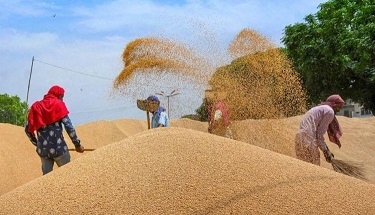
It seems that there is no end to farmers plight soon, even though recently State Government has extended the date of wheat procurement to May 23 from May 9. Farmers alleged that they have to either sell their crops at a price lower than MSP to traders due to delayed procurement process or bear additional burden to keep the produce safe from untimely rain.
Union Agriculture Minister, Shivraj Singh Chouhan who hails from Madhya Pradesh itself, held a mega event ‘Unnat Krishi Mahotsav’ in presence of Defence Minister Rajnath Singh in Raisen district. Where the later announced to procure food grains, fruits, and vegetables directly from local farmers from nearby regions for Army cantonments.
Responding to this helping gesture, farmers from other regions pose a question, “Where will we go to sell our produce at justified rates?”
Amid all this, State Government in a bid to calm down aggrieved farmers, extends the procurement date and pay four times the amount to rural farm land owners in case land acquisition takes place. But farmers are still up in arms and some organisations are planning to intensify their protest.
The Samyukt Kisan Morcha (SKM) has expressed outrage over the situation prevailing across the State, where farmers’ produce is not being procured, and they are being forced to sell their crops at prices significantly lower than the declared Minimum Support Price (MSP). During a meeting held in Bhopal on Wednesday, the SKM expressed astonishment as to why the server invariably goes down precisely when the time comes for farmers to register.
Presided over by senior farmer leader Prahlad Vairagi, the meeting also discussed ongoing issues across the State—specifically, forced land acquisition being carried out without farmers’ consent, without taking them into confidence, and without providing adequate compensation or proper rehabilitation; changes being introduced in the power sector (including the installation of smart meters); and apprehensions regarding potential shortages of fertilisers and diesel.
The Samyukt Kisan Morcha stated that it appears as though the Central and State governments have declared war on the farmers. Farm loan waivers have not materialised; arrangements for fertiliser supply remain undone; there is not even an assurance regarding the procurement of Moong (green gram) at the MSP; and there is no guarantee that payments for wheat procured through the e-procurement system will be released with immediate effect.
Addressing all these issues—along with other questions pertaining to agriculture, farming practices, and land rights—the Samyukt Kisan Morcha has devised a plan to launch a State-wide campaign, culminating in the preparation for an indefinite protest movement in the State capital.
This initiative will commence in May with divisional-level farmers’ conferences held across the State, followed by a state-level convention to be held in the capital on June 7. The various phases of the protest movement will be announced during this convention.
Concurrently, a drive will be undertaken to bring all organisations currently active at the district or local levels under the umbrella of the Samyukt Kisan Morcha.
The SKM Madhya Pradesh has resolved to welcome and affiliate with any organisation that is willing to join this collective movement while upholding the spirit of broad-based unity. This participation will be determined by the extent of his involvement in the struggles of Madhya Pradesh; no other criterion shall serve as the basis for this.
At the same time, the opposition congress party is raising the issue prominently in the State.
Jitu Patwari, President, Madhya Pradesh Congress Committee alleged it is the failure of the wheat procurement system and the heavy losses incurred by farmers.
Wheat procurement that has emerged in Madhya Pradesh this year is extremely alarming and anti-farmer. Due to the State Government’s lax arrangements, repeated extensions of deadlines, and the failure of the procurement machinery, lakhs of farmers have had to suffer heavy financial losses.
He said State Government had promised the farmers of the State that wheat would be procured at a rate of Rs 2,700 per quintal—a promise which, to this date, you have failed to fulfill. Even today, procuring wheat at Rs 2,625 per quintal—merely by adding a bonus of Rs 40 to the Minimum Support Price (MSP) of Rs 2,585 fixed by the Central Government.
The irony is that in the neighboring State of Rajasthan, farmers are receiving a rate of Rs 2,735 from a BJP government itself; whereas in Madhya Pradesh—despite the presence of a so-called ‘Double Engine Government’—farmers are being denied their rightful dues.
In the State, wheat was sown across approximately 40.58 lakhs hectares, and the total production is estimated to be around 245 lakhs metric tonnes. In stark contrast, the procurement target set by the government is merely 100 lakh metric tonnes—which constitutes less than 50% of the total production. This situation prevails even
while the governments in Punjab and Haryana procure approximately 70% and 60% of the total wheat produce, respectively.
The government’s repeated extensions of the slot booking deadlines clearly demonstrate that the procurement machinery has failed completely.
Due to processes such as re-verification, farmers are, even today, unable to even book their slots. In the case of small farmers, only 9.5 lakhs metric tonnes of wheat have been procured over a period of 15 days; this makes it evident that—assuming all farmers were to undergo weighing simultaneously—it would take approximately 140 days to complete the entire procurement process at this current pace, which is completely impractical. Due to this mismanagement, more than 50% of the State’s farmers were compelled to sell their produce in the open market (Mandi), where they received a price of merely Rs 1,800 to Rs 2,200 per quintal. While the government ought to have ensured the procurement of produce from farmers at the declared price of 2,625 per quintal, this objective could not be effectively achieved either.
The current plight of the farmers is extremely dire; they require immediate funds to meet expenses related to weddings, children’s school fees, loan repayments, and other necessities. Consequently, they are unable to safely store their produce in their barns for extended periods and are, out of sheer compulsion, forced to sell it at distressingly low prices.
Jitu Patwari, President, Madhya Pradesh Congress Committee, wrote a letter to Chief Minister Dr Mohan Yadav demanding, accountability must be fixed for the delays and mismanagement that occurred during the wheat procurement process.
Farmers who were forced to sell their wheat at a price lower than the declared rate of Rs 2,625 must be compensated by the government for the difference amount. The slot booking and weighing procedures must be made simpler and more transparent.
The procurement target should be increased to cover at least 60–70% of the total agricultural output. Farmers who were unable to repay their loans by the stipulated deadline should be removed from the category of ‘defaulters,’ and all accrued interest on their loans should be completely waived. This is the time to rise above politics and ensure justice for the farmers. If the government genuinely intends to work in the best interests of the farming community, it must take immediate and decisive action.