Sironcha’s hidden wings: 15 new butterfly species uncover Gadchiroli’s unseen biodiversity wealth
| Date :07-May-2026 |
By Simran Shrivastava :
Deep inside the forests of Sironcha in Gadchiroli district, scientists have uncovered a striking explosion of butterfly life that is now altering the biodiversity map of Vidarbha. A year-long scientific survey in the Sironcha Forest Division documented 137 butterfly species, including 15 species never before recorded in the region.
The discovery has drawn attention to the dense tropical landscapes of Sironcha near the Maharashtra-Telangana border, where moist and dry deciduous forests continue to shelter fragile and rarely documented insect life.
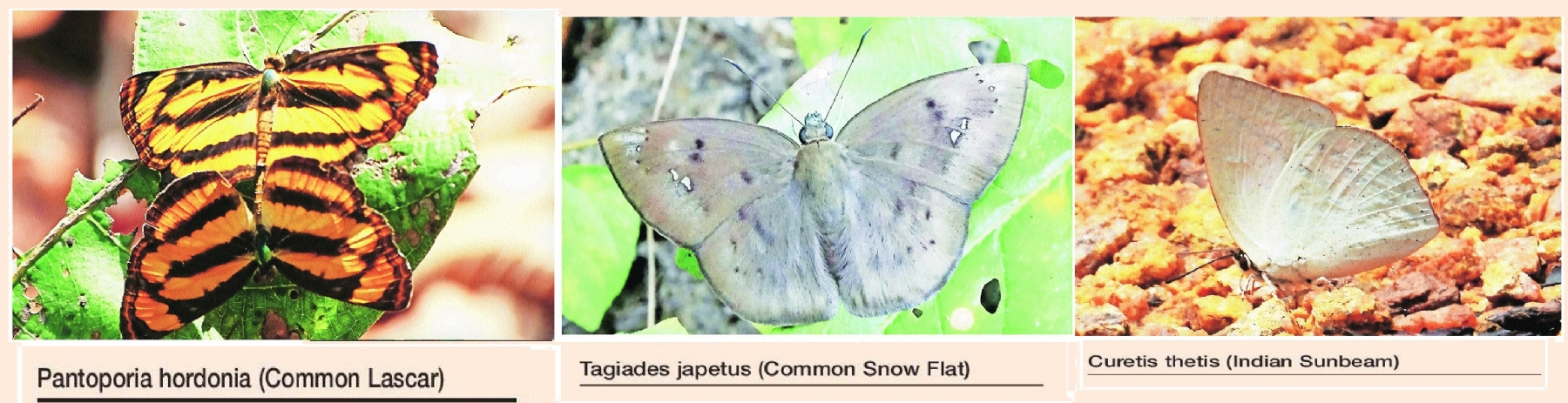
The newly recorded species include Athyma Ranga (Blackvein Sergeant), Athyma Selenophora (Staff Sergeant), Pantoporia Hordonia (Common Lascar), Tanaecia Lepidea (Grey Count), Curetis Thetis (Indian Sunbeam), Rapala Varuna (Indigo Flash), Rapala Pheretima (Copper Flash), Horaga Onyx (Common Onyx), Hypolycaena Othona (Orchid Tit), Spalgis Epius (Apefly), Tajuria Jehana (Plains Blue Royal), Zesius Chrysomallus (Redspot), Gangara Thyrsis (Giant Redeye), Hyarotis Adrastus (Tree Flitter), and Tagiades Japetus (Common Snow Flat).
The research was carried out by Poonam Pate, Director, Maharashtra Gene Bank Project (Special Cell), Maharashtra State Biodiversity Board (MSBB); A W Talandi and L H Choudhari from the Sironcha Forest Division; and Dr Ashish D Tiple, Associate Professor and Head, Postgraduate Department of Zoology, Dr R G Bhoyar
Arts, Commerce and Science College,
Seloo, Wardha.
Researchers conducted field surveys with support of the State Forest Department across forest ranges over an entire year.
“The study found strong representation from the Lycaenidae and Nymphalidae butterfly families,” explained Dr Tiple.
The study also documented 19 butterfly species protected under the Wildlife (Protection) Act, 1972. This gave the findings added conservation significance. Expanding human activity, habitat disturbance, and degradation of native vegetation could place several rare species under pressure if long-term ecological safeguards are not strengthened.
Frontline forest workers played a striking role in documenting butterfly diversity. Arun Talandi, a forest guard, Sironcha Forest Division, and Laxman Choudhari, a forest labourer, became major contributors.
Dr Tiple asserted that while diversity has previously been studied in tiger reserves such as Tadoba Andhari Tiger Reserve (TATR), Pench Tiger Reserve (PTR), and Bor Tiger Reserv (BTR), forest divisions like Sironcha of Gadchiroli remained unexplored from detailed scientific documentation until now.
Newly-recorded species trace origin to tropical forests
of South, Southeast Asia
The newly recorded butterfly species documented from Sironcha trace
their origins to the tropical forests
of South and Southeast Asia. Many of
them are known from countries such as India, Nepal, Bhutan, Bangladesh,
Sri Lanka, Myanmar, Thailand, Malaysia, and parts of Indo-China, where warm
and humid forest ecosystems support rich butterfly diversity. Their presence
in Sironcha reflects the ecological
connection between central Indian forests and the larger Oriental biodiversity region.
Newly-recorded species trace...
Within India, these butterflies are commonly associated with forested regions of the Western Ghats, northeastern states, Himalayan foothills, eastern India, and parts of central India. Several species are usually found in dense woodland habitats with rich vegetation and perennial water sources. Their discovery in Sironcha highlights the ecological importance of the Gadchiroli forest as a habitat supporting species that are otherwise linked with some of India’s most biodiversity-rich regions.