Bastar’s Megalithic Tradition, A living link to the Iron Age
| Date :01-Jun-2026 |
By Dr Abhinav Mishra :
Rooted in ancient Iron Age megalithic cultures, broadly dating back to the first millennium BCE, Bastar is among the rare regions in the world where megalithism is not merely an archaeological memory but a living tradition. Megalithism refers to the practice of raising large stone structures as graves or memorials for the dead. While such memorials elsewhere are studied largely as relics of the past, in Bastar they continue among tribal communities as part of ancestor veneration and living cultural heritage, giving the region a distinctive place in the global cultural and archaeological landscape.
Megalithic culture around present-day Chhattisgarh was first documented by J D Beglar in 1873 and later studied by noted scholars Verrier Elwin, Christoph von Furer-Haimendorf and W V Grigson. In a 2018 study, Vinay Kumar of Banaras Hindu University further documented Bastar’s megalithic rituals and practices, detailing the beliefs and ceremonies associated with these memorials.
Shaped by an animistic worldview and belief in life after death, Bastar’s tribal communities view death as a continuation of the soul’s journey. Among the Muria tribes, the deceased are revered as Pitar Duma, or divine ancestors, and are given a permanent abode at a separate village site according to clan lineage. This belief is expressed through vertical stone memorials, known archaeologically as menhirs, which are erected to preserve the soul of the dead.
Locally, these memorials are called Anal Duma, Kotkal, Gayatakalak or Kalak Ursana. Several tribal communities believe every human being has two souls: the life spirit and the shadow. The life spirit goes to Budha Deo, while the shadow remains in the village after a memorial is erected. Before a memorial is installed, priests, relatives and friends select a rocky hillock and mark the spot with saja wood. One of the priests places his hand on the chosen rock, invokes the soul of the deceased and asks it to stay and rest there.
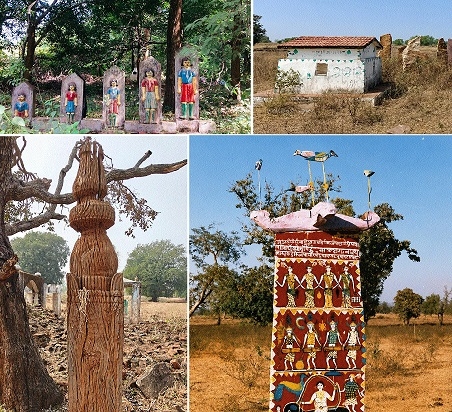
Relatives usually erect the memorial seven days after the death rituals with customary offerings. Once the menhir is raised, animal sacrifice and a feast follow. Depending on the family’s means, the ceremony may also be performed after five, seven or nine years. The form and scale of memorials vary with age and the nature of death. Some tribal communities believe that a pleased ancestral soul causes the memorial stone to grow in size, which is considered auspicious for the family. The tradition continues, though in modified form, among the Marias, Murias, Dorlas and Dhurwas across Bastar. With suitable stones becoming harder to find, wooden pillars and cemented cenotaphs, often bearing clan symbols and ritual motifs, are sometimes used instead. Today, the tradition faces challenges from industrialisation, infrastructure projects and stone quarrying. Yet many megalithic sites are still treated as living monuments, and any attempt to disturb them is considered a bad omen. The Tribal Museum at TRTI showcases this tradition as a living cultural practice of Bastar.