City running out of places to breathe for free
Date :17-Jul-2026
By Reema Mewar :
As Nagpur’s infrastructure burgeons, its third spaces fade away quietly
if one asks residents of Nagpur where they can spend an entire evening without having to pay an entry fee or feel the need to buy something, what would the answer be? Apart from a few temples and a handful of parks and lakes, there are not many third spaces in city that offer the simple pleasure of lingering.
From a sociological perspective, third spaces are social environments that are separate from homes (first spaces) and workplaces/schools/offices (second spaces). Third spaces serve a very important purpose in society -- they are accessible
public or semi-public spaces that encourage community-building, reduce isolation, and encourage people to come out of their homes to interact with everyone, be it their loved ones or strangers, out of a genuine desire to do so rather than
an obligation.
For the millennial and Gen-Z crowd who grew up in Nagpur, the Children’s Traffic Park in Dharampeth harbours these memories.
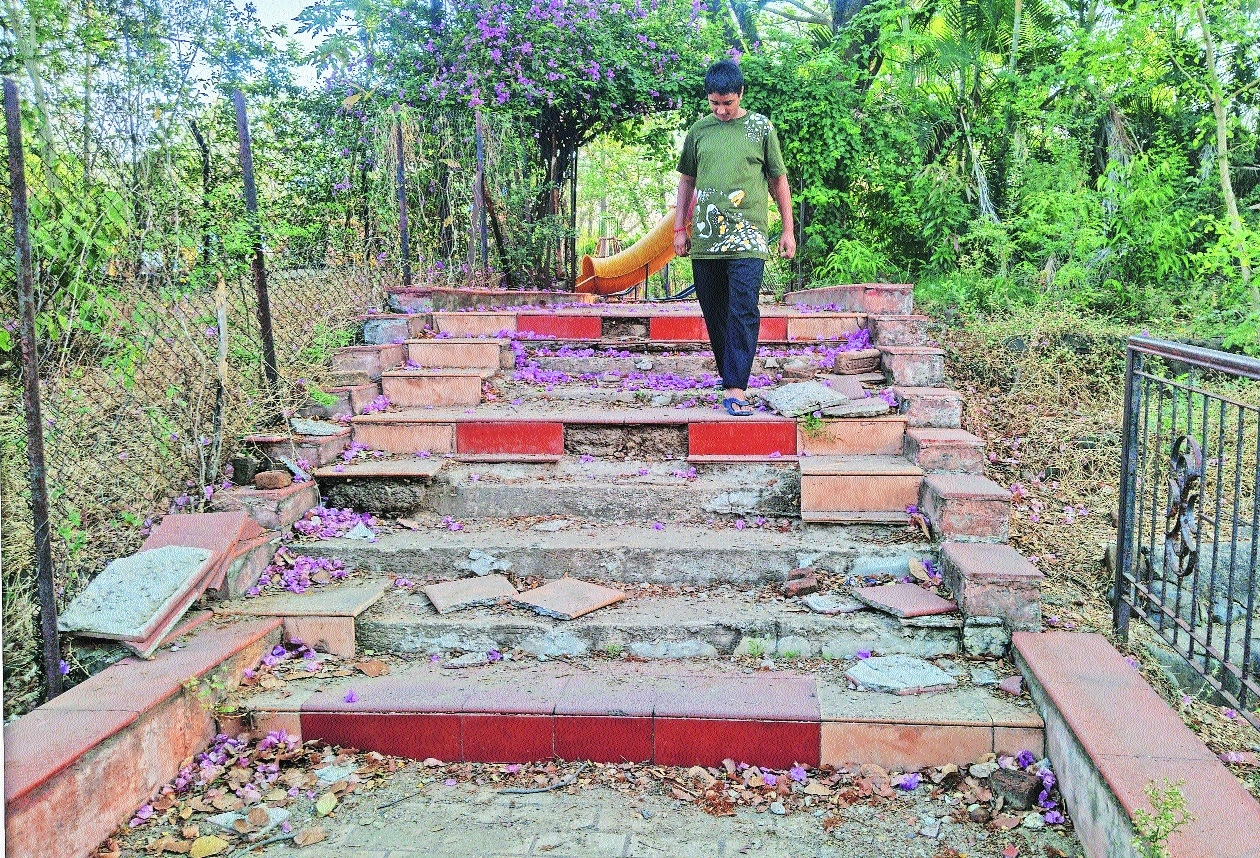
Dilapidated stairs at the Ambazari garden, which is open for
walkers in the mornings. (Pic by Anil Futane)
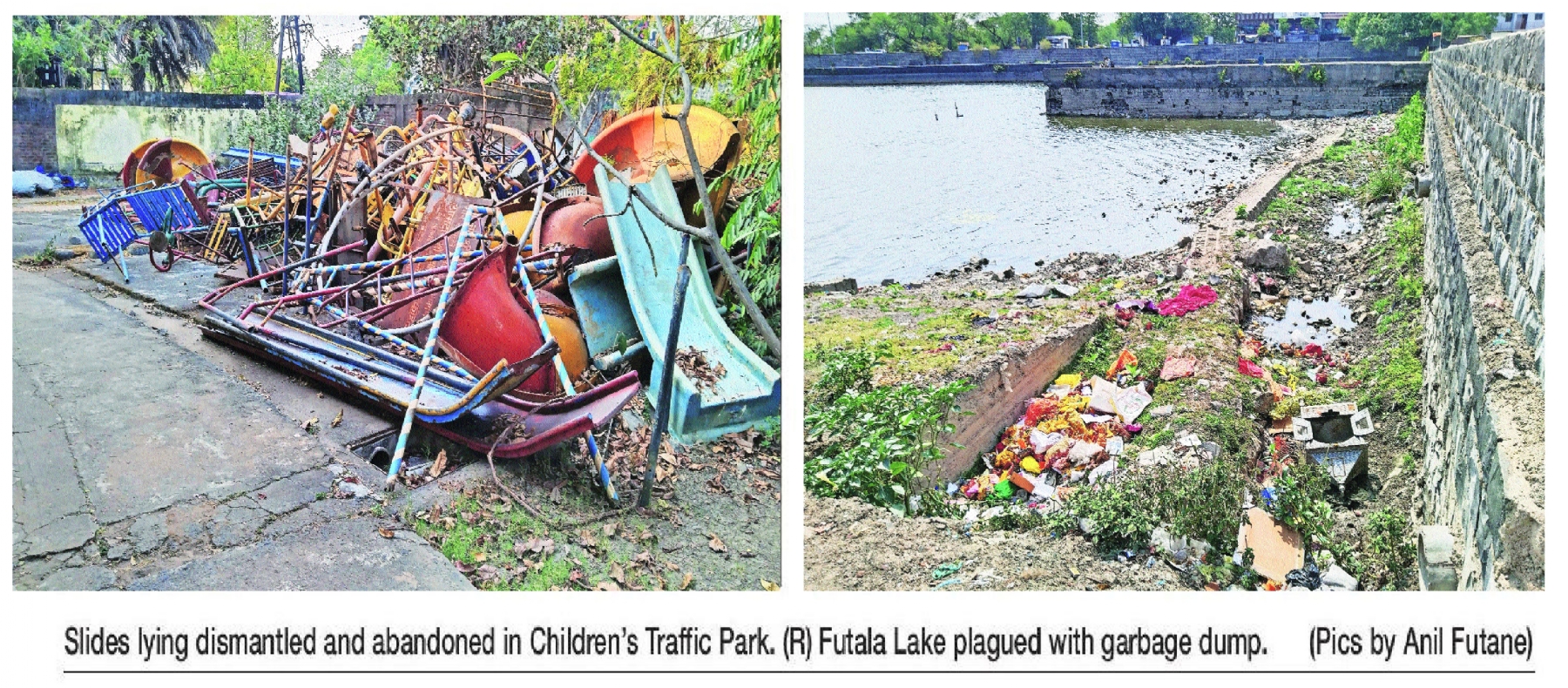
Now a mostly silent and dilapidated space, the Children’s Traffic Park was once alive with the sound of fascinated children riding the toy train, young teens cycling on the bicycle track, older children enjoying the mechanical
rides or playing in the ground, and senior citizens sitting
on benches, chatting or reading newspapers.
The Children’s Traffic Park was the perfect example of a lively, thriving third space, where organic entertainment was accessible at nominal prices. Madhuri Duggal, a resident of Nagpur, reflected on her experiences in Traffic Park as a child. “I’m struggling to find a similar kind of entertainment for my children.
Of course, there are classes and so many other fun things coming up in Nagpur, but they are all paid. There is no real organic interaction as such.”
Nagpur’s lakes, once the city’s main attraction, have lost their charm due to haphazard development. Madhukar Vastani, a senior citizen and resident of Gandhi Nagar, recalled his time spent at Ambazari Lake when his children were still young. “We used to take a large mat, homemade snacks and water and have a picnic. It did not cost us anything, but they are still the happiest memories I have with my children.”
“Now, the atmosphere is no longer family-friendly. A lot of couples come there and indulge in inappropriate behaviour in public,” Vastani said.
Even the Japanese Gardens are facing the same problem due to lack of sufficient enforcement. Places like the Van Udyaan in Seminary Hills and the Botanical Gardens near Futala Lake
stand either abandoned and crumbling, or closed down altogether.
Even where public parks are available and well maintained, access is not always guaranteed. Shraddha Paranjpe, a college student, recalled an incident when she and her friends were sitting at a neighborhood park. “We were just talking among ourselves when a man came up to us and told us to leave, saying the park was meant only for local residents,” she said. “When public spaces become restricted like this, they stop serving their purpose as spaces where anyone can simply come, sit, and spend time,” Paranjpe opined.
As Nagpur continues to expand with new roads, flyovers, metro connectivity and commercial development, our infrastructure is undeniably progressing. However, equally important are the spaces where people can simply exist without the expectation of spending money. Slowly, Nagpur is becoming a city that is well-connected, but increasingly disconnected from the people who call it home.