HISTORIC LIFT OFF !
Vikram-1, India’s 1st private rocket, successfully places tech payloads into low Earth orbit
Vikram-1, India’s 1st private rocket, successfully places tech payloads into low Earth orbit
| Date :19-Jul-2026 |
By Jemima Raman
SRIHARIKOTA,
IN ITS maiden voyage, India’s
first homegrown private orbital
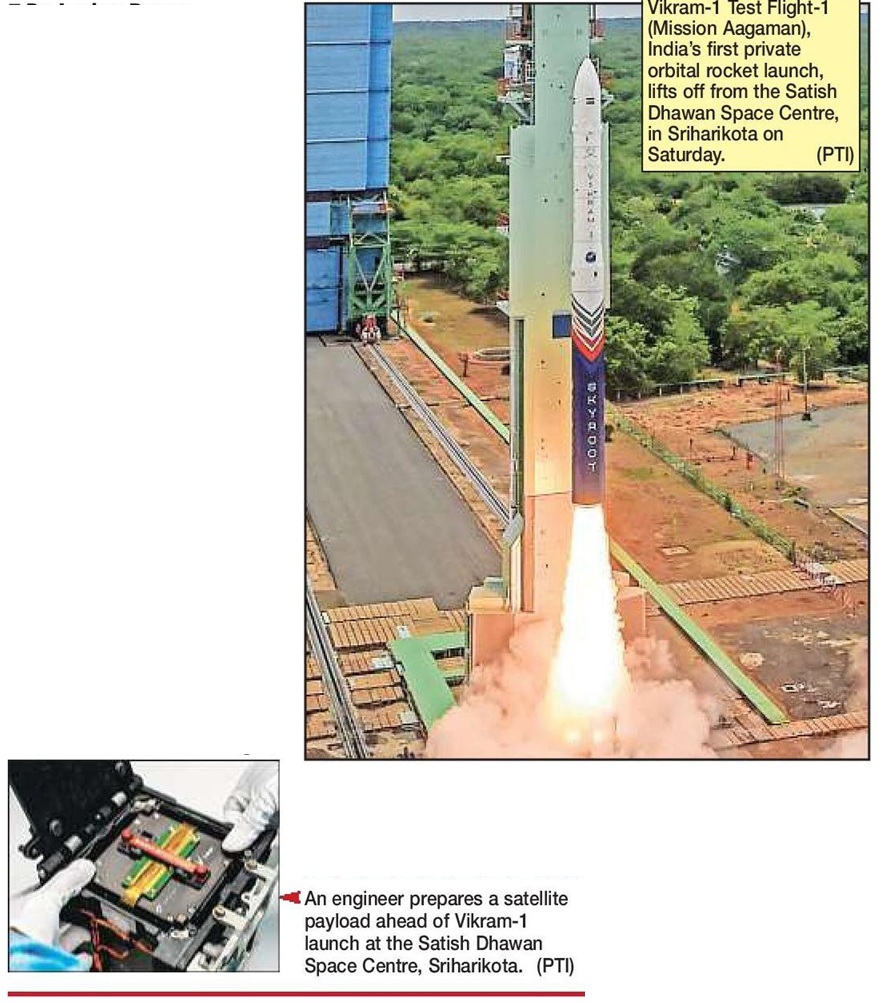
rocket,Vikram-1 Test Flight-1 on
Saturday successfully placed
multiple technology demonstration payloads and postcards,
including from Prime Minister
Narendra Modi into a low Earth
orbit, with the PM calling the
mission as a “defining moment”
in the country’s space journey.
Dubbed ‘Mission Aagaman’
(arrival), it marks the entry of
India’s private space sector into
the orbital launch market, spearheaded by Hyderabad-based
Skyroot Aerospace.
The mission was a “grand success,” the company said.
The four-stage, seven-storeytall Vikram-1 rocket lifted off
majestically at 12.05 pm amid
cloudy skies from the first launch
pad of ISRO’s Satish Dhawan
Space Centre, leaving behind
plumes of orange smoke and
marking a new era from this
spaceport.
A“planned hold” due to apparent navigation issues forced a
revised launch time of 12.05 pm,
as against the originally planned
11.30 am.
After its ascent, the primary
payloads -- technology demonstrators from Grahaa Space,
Cosmoserve, DCubed, and
Skyroot’s SCOPE -- were sequentially deployed into a 450 km Low
Earth Orbit (LEO).
The launch vehicle also successfully deployed a micro-art
payload, an 18-karat gold rocket and a handwritten postcard rockets and engines after these
icons,” it added. CEO and cofounder of Skyroot Aerospace,
Pawan Kumar Chandana and
co-founder Naga Bharath Daka
were present at the ISRO’s
Mission Control Centre (MCC)
for the launch.
Chandana informed that the
rocket was completely
designed and made in India.
Referring to PM Modi’s post
card bearing the message
“Vande Mataram,” a slogan
which the launch vehicle carried to a low Earth orbit of 450
km, Chandana said “your card
has successfully reached orbit.
Vande Mataram is in orbit.”
Chandana said, “we are very
proud that the Government has
enabled us and opened up the
sector to private players, and
now we stand as India’s first private company which has
launched a rocket to orbit and
also created a global milestone.
All from India with a fully, fully Indian team, 100 per cent
built in India.” Daka said India
was the third country, after the
US and China with private sector launch capability.
ISRO chief V Narayanan credited PM Modi for opening up
the space sector for the startup ecosystem of the country.
“In 2020, the space sector
reform was announced. Today,
within six years, a startup company has successfully placed
the satellite in the first attempt
in the orbit. It is really a great,
satisfying moment,” he said.
He also lauded the young
team of Skyroot Aerospace, saying “it was told the average age
is 28 years.”
According to the company,
the engineering data collected
during this test flight will be
analysed to validate guidance
and navigation systems, and
to guide future refinements for
commercial satellite missions.
With its Saturday mission,
Skyroot Aerospace successfully demonstrated its orbital
launch capability with the
maiden flight of the Vikram-1
launch vehicle, moving beyond
the suborbital flight achieved
by its Vikram-S mission in 2022.
The successful flight validated the performance of the
rocket’s all-carbon composite
structure and 3D-printed
engines in a real flight environment, features claimed by
the company as ‘first’.
This historic milestone is expected to
strengthen India’s position in
the fast-growing global small
satellite launch market,
expanding the country’s presence in space alongside ISRO. The payloads that piggybacked Vikram-1 include
Cosmoserve Space’ Embrace
(mission name), an in-orbit
demonstration of robotic arms
capable of removing space
debris, Solaras by Grahaa Space
which is a compact satellite
mission developed to demonstrate new capabilities in LEO.
According to the company,
Scope satellite by Skyroot
Aerospace is an in-house experimental payload developed to
test space technologies in
future missions.
Cosmic Bloom, an “artistic
lab-grown diamond” by
Cosmos Diamonds and
German test payload uD3PP
and mD3RN by Dcubed also
reached the space on Saturday.