TATR starts wetland restoration with artificial perching to boost waterbirds, crocodile habitats
Date :06-Jul-2026
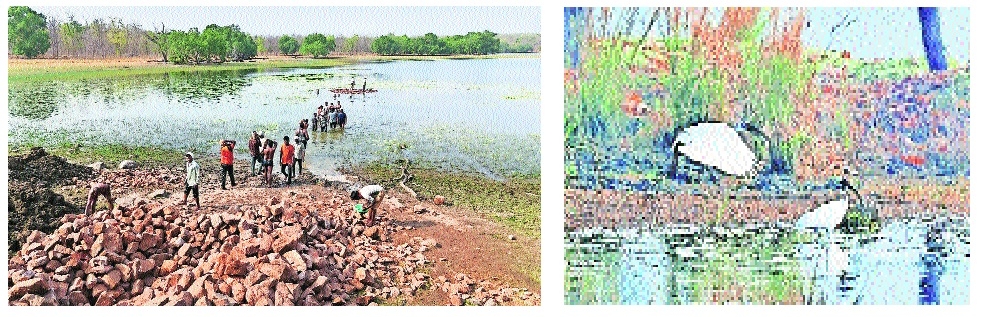
Labourers constructing an artificial perching inside a waterbody situated in TATR.
By Kaushik Bhattacharya :
Forest Deptt has started creating 262 artificial perching in water bodies and seven sandbanks on all waterbodies and lakes available in the reserve
Tadoba-Andhari Tiger Reserve (TATR) has started wetland development and restoration project in core and buffer areas to achieve broader goal of its Rewilding Project.
For this, the Forest Department has started creating artificial perching in water bodies and sandbanks on all lakes available in the tiger reserve.
“Artificial perching provides excellent vantage points for various birds like kingfishers, egrets, and raptors to spot and hunt fish or amphibians,” said Dr Prabhu Nath Shukla, Field Director, TATR to ‘The Hitavada’. “Perching will encourage a wider variety of birds such as herons, storks, and the Grey-headed Fish Eagle to inhabit restored wetlands. It will also help to be safe from predator
birds,” said Dr Shukla. The management is constructing 262 artificial perching in which 154 are in buffer and remaining in core area in TATR. It took place on the centre of 103 water bodies or the lake situated in five ranges of TATR. By installing these structures in wetland areas, the reserve creates vital resting and hunting platforms for waterbirds and raptors, enhancing the ecosystem while empowering local women from buffer villages through eco-restoration employment, said the Field Director.
On perching sites, the department is strategically placing logs and exposed rocks in and around water bodies provide safe, elevated platforms. These platforms are also helpful for crocodiles in TATR. Because crocodiles are cold-blooded, they rely on these perches to bask in the sun and regulate their body temperature without fully leaving the water.
“Along with this, we are constructing sandbanks in all lakes for residing crocodiles of the tiger reserve. These artificial sand beaches provides gentle sloping were engineered along water bodies to allow crocodiles to easily haul themselves out of the water. These beaches are critical for female crocodiles to dig nest holes during the winter breeding season,” Dr Shukla told.
These habitat developments facilitate thermoregulation (basking) and provide essential nesting and egg-laying sites for the reptiles.
As per the information, in five ranges including Tadoba, Kolsa, Karwa, Kolara and Moharli, the management has constructed seven sand banks for more than 100 crocodiles of TATR. Along with this, in all these ranges, 33 stone mounds are also in construction for crocodiles. The Field Director also informed that the management planted 2,059 saplings on the banks of 103 waterbodies of TATR for nesting of waterbirds on the banks of the lakes. “These modifications are integrated into TATR’s broader ecological and landscape restoration initiatives, which aim to revive damaged lands, prevent habitat fragmentation, and sustain apex predator and prey dynamics across the reserve,” explained Dr Shukla.