JUI-F chief warns Asim Munir ofPak’s further dismemberment
| Date :25-Aug-2026 |
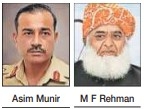
ISLAMABAD :
SENIOR Pakistani leader and
Jamiat Ulema-e-Islam (F) (an
Islamic fundamentalist and
Islamist political party in
Pakistan) chief Maulana Fazlur
Rehman has launched a sharp
attack on Pakistan Army Chief
Field Marshal Asim Munir, recalling the country’s humiliating
defeat in the 1971 war against
India and warning that prolonged oppression, violence and
bloodshed could eventually lead
to fresh geographical changes in
the region.
Addressing a JUI-F convention in Peshawar, Rehman questioned the military establishment’s repeated claims of
strength and its aggressive posture while pointing to the hardships being faced by ordinary
people across the country.
Taking a direct swipe at the
top military leadership, the JUIF chief said, “We are the protectors of this country. No one’s
father can harm this country. I
agree, you are very powerful,”
while questioning whether such
assertions of power could protect the country from internal
turmoil and growing public distress. Rehman then drew a parallel between the present-day
statements of Pakistan’s military leadership and the events
surrounding the 1971 war with
India. He recalled how the
Pakistani military had made
strong declarations of continuing the fight until the very end
before eventually surrendering in Dhaka.
The 13-day India-Pakistan
war in December 1971 ended
with the surrender of around
93,000 Pakistani troops in
Dhaka on December 16. The
defeat resulted in the collapse
of Pakistan’s eastern wing and
ultimately led to the creation
of Bangladesh.
Recalling the
statements made by then
Pakistan President and military ruler General Yahya Khan
shortly before the surrender,
Rehman said the establishment
had made similarly strong
claims in the past but failed to
deliver on those declarations
when the situation reached its
decisive stage.
“But I remember, and maybe
some elders will too, that in
December 1971, one day before
laying down arms, General
Yahya Khan had addressed the
Army and had said, ‘We will
fight in the streets, deserts,
fields, factories, mountains, and
we will fight against them. We
will fight’. We heard these big
words then, too,” Rehman said.
“Why are you putting the
country and the people to the
test? Why are you having fun
when your public is suffering?”
Rehman asked, highlighting
what he described as the continuing distress of the Pakistani
people. Referring to the prolonged period of conflict and
bloodshed in the region, he
said that violence and instability had continued for
decades, raising concerns over
their possible consequences
for the country’s future.
“When the revolution came
in Afghanistan in 1989, and the
war started... It’s been 45-46
years; blood has been flowing
for about half a century. When
blood flows like this, then it is
a sign of geographical changes,”
the JUI-F chief stated.
“If it is a sign of oppression.
Then at least inform us of your
intentions. We are tolerating it
and will continue to tolerate it,”
Rehman said.